Linear-optical generation of approximate higher-component cat states
Abstract
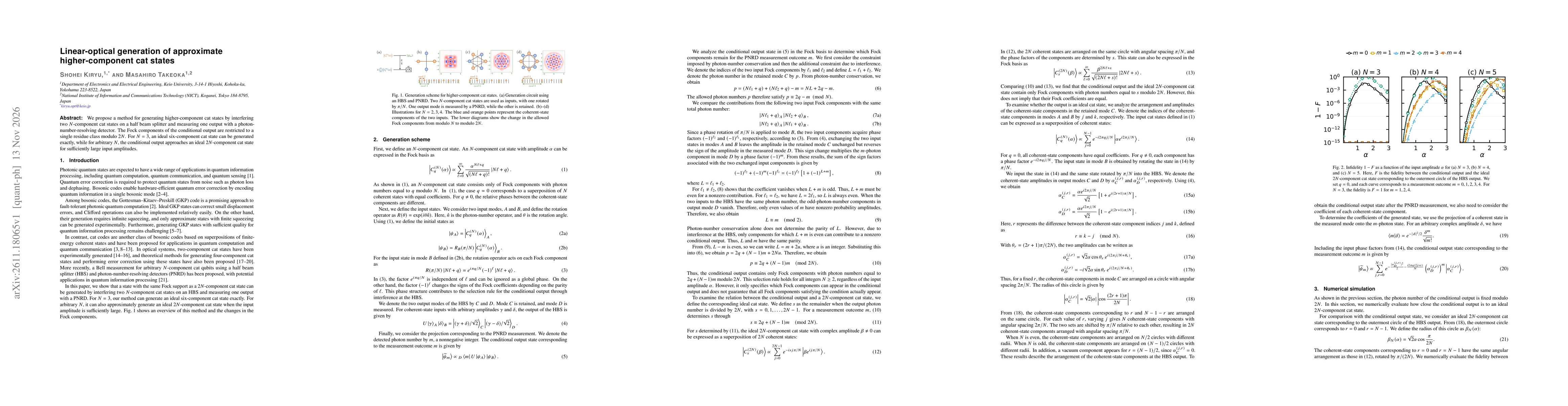
We propose a method for generating higher-component cat states by interfering two $N$-component cat states on a half beam splitter and measuring one output with a photon-number-resolving detector. The Fock components of the conditional output are restricted to a single residue class modulo $2N$. For $N=3$, an ideal six-component cat state can be generated exactly, while for arbitrary $N$, the conditional output approaches an ideal $2N$-component cat state for sufficiently large input amplitudes.
Analysis
AI-generated · verify against the original paper
Generated Jan 1, 0001ResultsWhat the authors found
- For N=3 the scheme generates an ideal six‑component cat state with unit fidelity for measurement outcomes m=1,2,4.
- For arbitrary N the conditional output approaches an ideal 2N‑component cat state as the input coherent amplitude becomes sufficiently large.
- The fidelity exhibits a non‑monotonic dependence on the input amplitude, decreasing at intermediate amplitudes and increasing again at large amplitudes.
LimitationsWhere the findings need caution
- For N>3 and finite amplitudes the output contains coherent‑state components with different radii, so it does not exactly match a 2N‑component cat state.
- The generated state depends on the specific photon‑number measurement outcome, and vacuum components can remain for certain outcomes.
MethodologyHow the work was done
The authors interfere two N‑component cat states on a half beam splitter, rotate one input by π/N, and perform photon‑number‑resolved detection on one output mode, post‑selecting on the detected photon number to obtain the conditional state in the other mode.
SignificanceWhy the work matters
This work provides a linear‑optical pathway to create higher‑component cat states, which are essential resources for rotation‑symmetric bosonic codes and fault‑tolerant photonic quantum information processing.
Technical contributionsWhat the work introduces
Introduction of a half‑beam‑splitter and photon‑number‑resolving detection scheme that restricts the Fock support of the conditional output to a single residue class modulo 2N, enabling exact and approximate generation of higher‑component cat states.
NoveltyHow it differs from prior work
First demonstration that interfering two N‑component cat states with linear optics can produce exact six‑component cat states and approximate 2N‑component cat states for arbitrary N, extending previous two‑ and four‑component cat generation methods.
Discussion 0