Linear-response magnetoresistance effects in chiral systems
Abstract
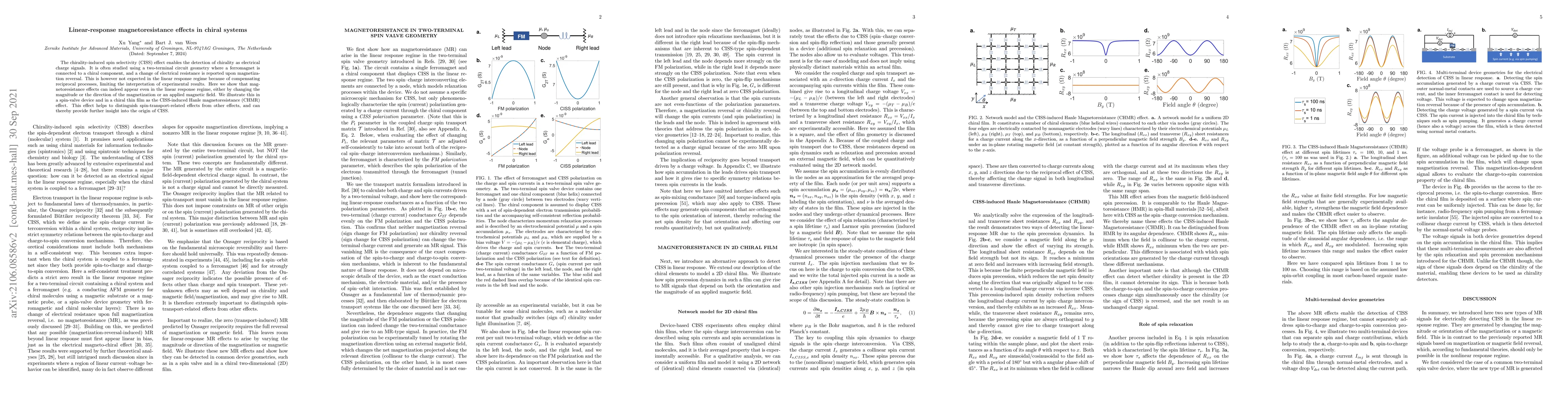
The chirality-induced spin selectivity (CISS) effect enables the detection of chirality as electrical charge signals. It is often studied using a two-terminal circuit geometry where a ferromagnet is connected to a chiral component, and a change of electrical resistance is reported upon magnetization reversal. This is however not expected in the linear response regime because of compensating reciprocal processes, limiting the interpretation of experimental results. Here we show that magnetoresistance effects can indeed appear even in the linear response regime, either by changing the magnitude or the direction of the magnetization or an applied magnetic field. We illustrate this in a spin-valve device and in a chiral thin film as the CISS-induced Hanle magnetoresistance (CHMR) effect. This effect helps to distinguish spin-transport-related effects from other effects, and can thereby provide further insight into the origin of CISS.
AI Key Findings
Get AI-generated insights about this paper's methodology, results, significance, and more — available when analysis has been generated.
Discussion 0