LLM-Guided Compositional Continual Learning for Robot Manipulation with Gated Low-Rank Experts
Abstract
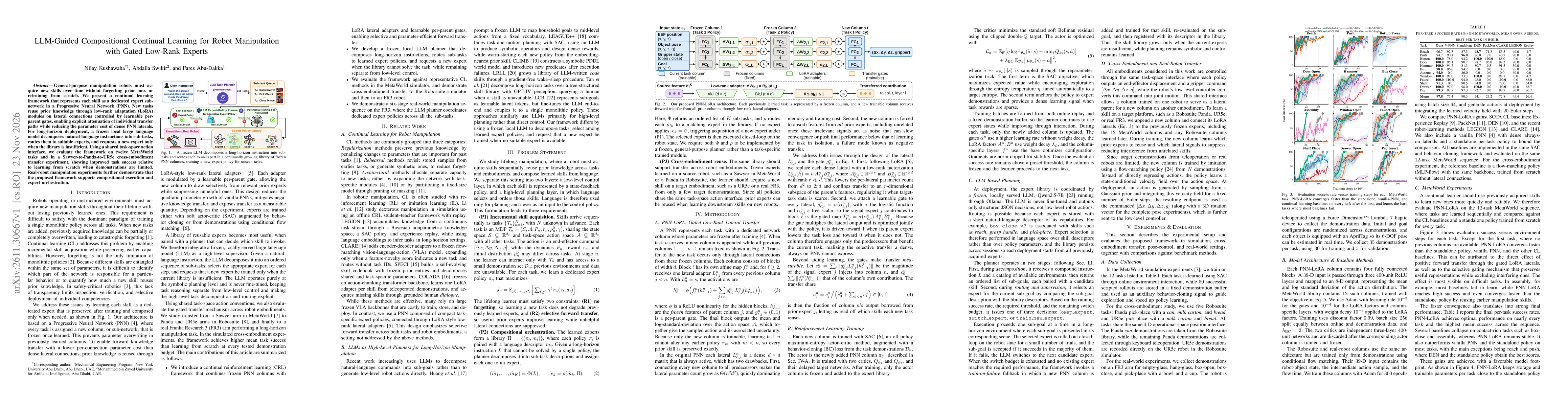
General-purpose manipulation robots must acquire new skills over time without forgetting prior ones or retraining from scratch. We present a continual learning framework that represents each skill as a dedicated expert sub- network in a Progressive Neural Network (PNN). New tasks reuse prior knowledge through low-rank adaptation (LoRA) modules on lateral connections controlled by learnable per-parent gates, enabling explicit attenuation of individual transfer paths while reducing the parameter cost of dense PNN laterals. For long-horizon deployment, a frozen local large language model decomposes natural-language instructions into sub-tasks, routes them to suitable experts, and requests a new expert only when the library is insufficient. Using a shared task-space action interface, we evaluate the framework on twelve MetaWorld tasks and in a Sawyer-to-Panda-to-UR5e cross-embodiment transfer experiment, showing improved task success relative to learning from scratch when demonstrations are limited. Real-robot manipulation experiments further demonstrate that the proposed framework supports compositional execution and expert orchestration.
AI Key Findings
Get AI-generated insights about this paper's methodology, results, significance, and more — available when analysis has been generated.
Discussion 0