Long-Range Reconnaissance Imager on New Horizons
Abstract
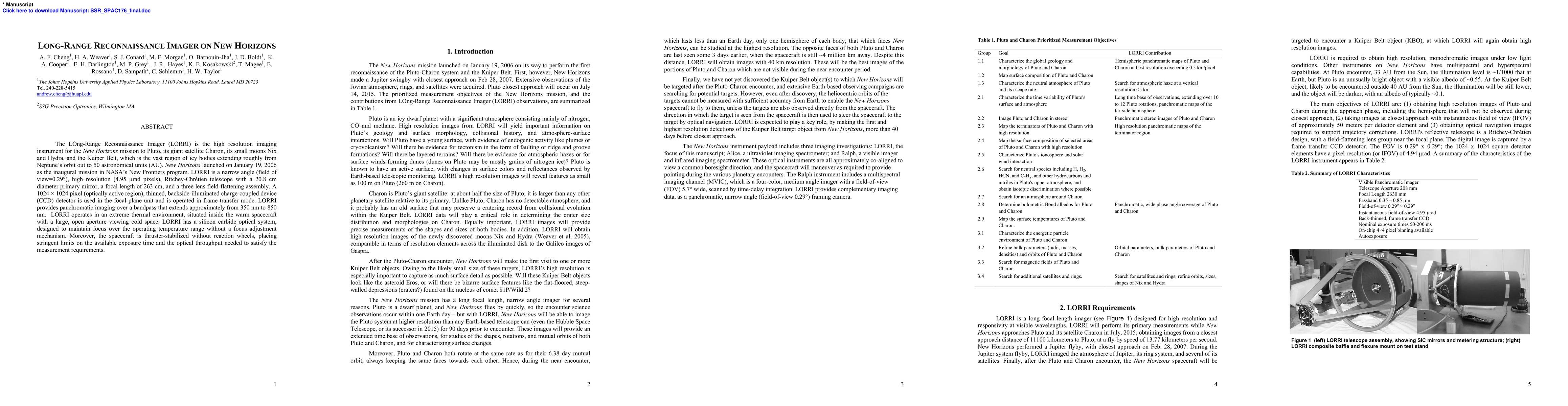
The LOng-Range Reconnaissance Imager (LORRI) is the high resolution imaging instrument for the New Horizons mission to Pluto, its giant satellite Charon, its small moons Nix and Hydra, and the Kuiper Belt, which is the vast region of icy bodies extending roughly from Neptune's orbit out to 50 astronomical units (AU). New Horizons launched on January 19, 2006 as the inaugural mission in NASA's New Frontiers program. LORRI is a narrow angle (field of view=0.29 deg), high resolution (4.95 microrad pixels), Ritchey-Chretien telescope with a 20.8 cm diameter primary mirror, a focal length of 263 cm, and a three lens field-flattening assembly. A 1024 x 1024 pixel (optically active region), thinned, backside-illuminated charge-coupled device (CCD) detector is used in the focal plane unit and is operated in frame transfer mode. LORRI provides panchromatic imaging over a bandpass that extends approximately from 350 nm to 850 nm. LORRI operates in an extreme thermal environment, situated inside the warm spacecraft with a large, open aperture viewing cold space. LORRI has a silicon carbide optical system, designed to maintain focus over the operating temperature range without a focus adjustment mechanism. Moreover, the spacecraft is thruster-stabilized without reaction wheels, placing stringent limits on the available exposure time and the optical throughput needed to satisfy the measurement requirements.
AI Key Findings
Get AI-generated insights about this paper's methodology, results, significance, and more — available when analysis has been generated.
Discussion 0