Look Less, Think Faster: Joint Token-Compute Adaptation for Multimodal LLMs
Abstract
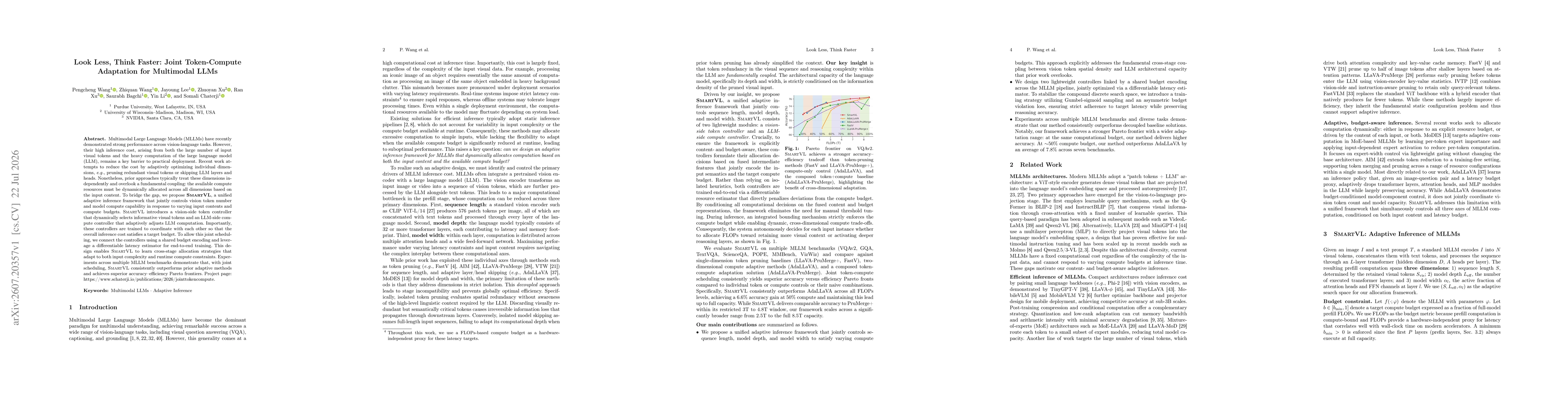
Multimodal Large Language Models (MLLMs) have recently demonstrated strong performance across vision-language tasks. However, their high inference cost, arising from both the large number of input visual tokens and the heavy computation of the large language model (LLM), remains a key barrier to practical deployment. Recent work attempts to reduce the cost by adaptively optimizing individual dimensions, e.g., pruning redundant visual tokens or skipping LLM layers and heads. Nonetheless, prior approaches typically treat these dimensions independently and overlook a fundamental coupling: the available compute resources must be dynamically allocated across all dimensions based on the input content. To bridge the gap, we propose SmartVL, a unified adaptive inference framework that jointly controls vision token number and model compute capability in response to varying input contents and compute budgets. SmartVL introduces a vision-side token controller that dynamically selects informative visual tokens and an LLM-side compute controller that adaptively adjusts LLM computation. Importantly, these controllers are trained to coordinate with each other so that the overall inference cost satisfies a target budget. To allow this joint scheduling, we connect the controllers using a shared budget encoding and leverage a differentiable latency estimator for end-to-end training. This design enables SmartVL to learn cross-stage allocation strategies that adapt to both input complexity and runtime compute constraints. Experiments across multiple MLLM benchmarks demonstrate that, with joint scheduling, SmartVL consistently outperforms prior adaptive methods and achieves superior accuracy-efficiency Pareto frontiers. Project page: https://www.schaterji.io/publications/2026/jointtokencompute.
Analysis
AI-generated · verify against the original paper
Generated Jul 24, 2026ResultsWhat the authors found
- Joint scheduling consistently outperforms prior adaptive methods across multiple MLLM benchmarks, improving accuracy under given compute budgets.
- The approach achieves superior accuracy–efficiency Pareto frontiers, demonstrating better trade-offs between latency, tokens, and model compute.
- Coordinated control enables cross-stage allocation strategies that adapt to input complexity and runtime constraints.
LimitationsWhere the findings need caution
- Relies on differentiable latency estimator which may not perfectly capture real-world hardware variances.
- Evaluation breadth may be limited to benchmark tasks and specific model architectures used in experiments.
MethodologyHow the work was done
SmartVL jointly optimizes vision token selection and LLM compute through two coordinated controllers (vision-side token controller and LLM-side compute controller) connected by a shared budget encoding and trained with a differentiable latency estimator for end-to-end optimization to satisfy a target compute budget.
SignificanceWhy the work matters
Demonstrates the importance of coupled optimization of input token pruning and model computation in multimodal LLMs, enabling practical deployments under dynamic budgets without sacrificing performance.
Technical contributionsWhat the work introduces
A unified framework (SmartVL) that simultaneously adapts vision token counts and LLM compute via coordinated controllers, a shared budget encoding to enable joint scheduling, and a differentiable latency estimator enabling end-to-end training for optimal accuracy-efficiency trade-offs.
NoveltyHow it differs from prior work
Introduces cross-dimensional dynamic adaptation that couples visual token pruning with LLM computation, addressing the coupling between input complexity and resource allocation absent in prior decoupled approaches.
Future workQuestions that remain
- Extend joint scheduling to more diverse hardware backends and latency profiles.
- Investigate robustness to distribution shifts in input complexity and budget fluctuations.
- Explore additional modalities and more fine-grained token/compute controls for even larger models.
Discussion 0