Lottery and Sprint Arcade: Enabling Player-Driven Game Editing with Generative AI
Abstract
Large language models (LLMs) are shifting game generation from offline automation toward play-driven modification through natural language interaction. In this work, we present a play-driven game editing system that enables players to modify a retro Space Invaders - style arcade game through voice-based natural-language commands during play. Spoken instructions are interpreted by an LLM and translated into structured updates of internal configuration parameters, allowing iterative play - edit - feedback cycles in an invader-style game environment without exposing underlying system details. The game includes approximately 100 editable configuration fields controlling mechanics, visuals, interaction patterns, and audio behavior, enabling gameplay transformation through incremental parameter changes. To investigate how users experience play-driven AI-mediated editing (RQ1) and how emergent editing patterns relate to variations in player experience (RQ2), we conducted a user study combining subjective evaluations, workload measures, and log-based analysis of editing behavior. Participants were able to modify gameplay with generally positive experiences and moderate workload, and interaction outcomes did not strongly depend on prior programming experience. Editing-log analysis revealed distinct experiential tendencies: adjustments to immediately perceptible parameters were associated with higher usability, whereas edits affecting core gameplay structures were more closely associated with enjoyment. Post-session reflections further identified diverse editing strategies, including exploratory experimentation, goal-driven structural modification, and iterative parameter tuning. These findings demonstrate that voice-driven editing can support accessible, play-driven human - AI co-creation within a structured invader-style arcade game environment.
Analysis
AI-generated · verify against the original paper
Generated Jul 14, 2026ResultsWhat the authors found
- Participants could modify gameplay with generally positive experiences and moderate workload.
- Editing outcomes did not strongly depend on prior programming experience.
- Editing-log analysis showed that changes to immediately perceptible parameters increased usability, while edits affecting core gameplay structures correlated with higher enjoyment.
- Post-session reflections revealed diverse editing strategies including exploratory experimentation, goal-driven structural modification, and iterative parameter tuning.
LimitationsWhere the findings need caution
- Study focuses on a single game genre and environment, limiting generalization to other genres or more complex systems.
- Relies on LLM interpretation of natural language, which may introduce variability in updates and potential misinterpretation of commands.
- Moderate sample size may constrain the robustness of observed patterns across diverse player populations.
MethodologyHow the work was done
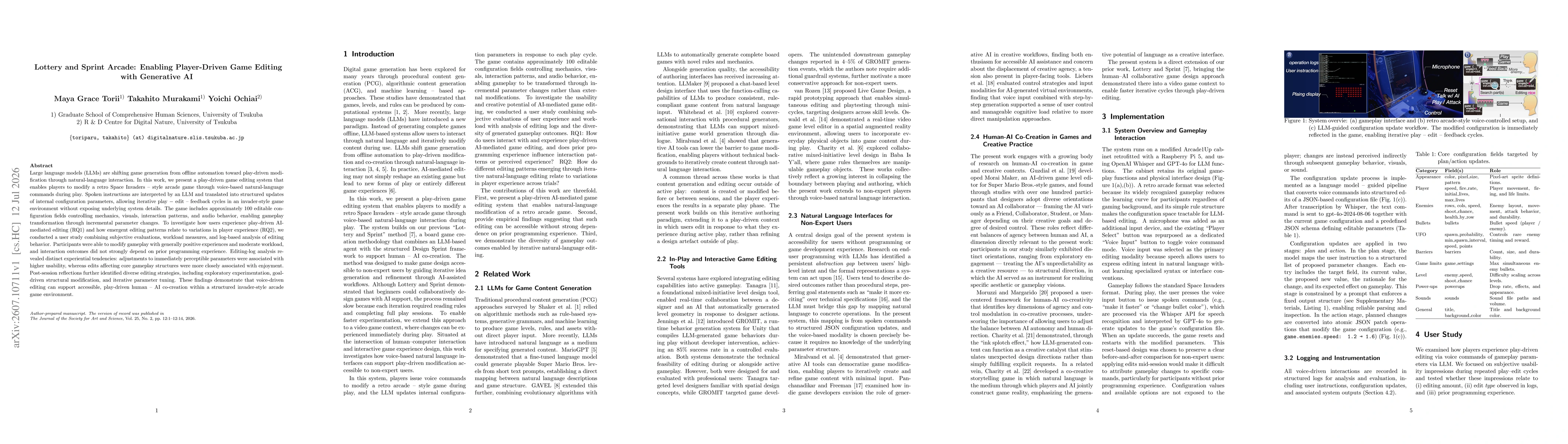
The study uses a play-driven game editing system where players issue voice-based natural language commands during play to modify a Space Invaders–style arcade game. An LLM interprets spoken instructions and translates them into structured updates of approximately 100 editable configuration fields, enabling iterative play-edit-feedback cycles. A user study combines subjective experience measures, workload assessment, and log-based analysis of editing behavior to explore user experience and patterns of editing.
SignificanceWhy the work matters
Demonstrates that voice-driven, AI-mediated game editing can support accessible, play-driven co-creation within a structured retro arcade game, enabling rapid iteration and experimentation without exposing underlying system details.
Technical contributionsWhat the work introduces
An end-to-end play-driven AI-assisted editing system that maps natural language commands to structured parameter updates within a retro arcade game, enabling immediate experiential feedback during play and supporting iterative human-AI co-creation.
NoveltyHow it differs from prior work
First demonstration of real-time voice-based natural-language editing in a playable game environment, combining an LLM-driven interpreter with a large set of editable configuration fields to enable user-driven transformation of gameplay during play sessions.
Future workQuestions that remain
- Investigate scalability to other game styles and more complex parameter hierarchies beyond 100 fields.
- Improve robustness and interpretability of LLM-driven updates to reduce misinterpretations.
- Explore long-term training effects on user editing strategies and perceived creativity.
- Develop metrics to quantify the relationship between editing patterns and long-term engagement.
Discussion 0