LuthorSQL: A One-Pass Text-to-SQL Model as System 1 for a Slower LLM Agent
Abstract
Frontier LLM agents that query databases with tools are among the most accurate text-to-SQL systems, but per-query calls to a hosted model are slow, costly, and expose sensitive organizational queries to external APIs. For example, a Claude Opus 5.5 agent serving 10,000 queries a day costs over $70,000 a year at list price. To what extent can local hardware already owned by an organization offload this burden without compromising the agent's accuracy? We present LuthorSQL, a non-autoregressive 7B text-to-SQL model that serves as a rapid System 1 gate for a slower LLM agent (System 2), escalating queries only when uncertain. LuthorSQL makes a single forward pass to predict slot scores over a bounded grammar for query plans, compiles and runs up to 32 candidate plans, and chooses an answer using a trained validator. On its own, LuthorSQL reaches 68.03% execution accuracy on BIRD's hidden test set at 0.84 s per question on a single GPU, maintains its accuracy in 9 GB with 8-bit quantized weights, and transfers zero-shot to Snowflake, BigQuery, MySQL, PostgreSQL, and DuckDB within 3.1 points of its native SQLite accuracy. Combined with Claude Opus 5.5 in a pre-registered confidence cascade over 227 questions on databases published after Opus's training cutoff, LuthorSQL answers nearly half of all questions locally and cuts API cost by 33.3% at the same accuracy. Finally, contamination probing shows that Opus reproduces 48-92% of public benchmark gold queries verbatim without seeing the schema; however, its tool-assisted accuracy holds on renamed schemas and reaches 95.6-97.4% on post-cutoff databases. Code and data: https://github.com/IAMIbrahimmemon/luthorsql
Analysis
AI-generated · verify against the original paper
Generated Jan 1, 0001ResultsWhat the authors found
- Achieves 68.03% execution accuracy on BIRD's hidden test set with 0.84 s latency per question on a single GPU.
- Maintains the same accuracy with 8‑bit quantized weights in a 9 GB footprint.
- Zero‑shot transfers to Snowflake, BigQuery, MySQL, PostgreSQL, and DuckDB within 3.1 points of native SQLite performance.
- In a cascade with Claude Opus 5.5, answers nearly half of 227 post‑cutoff questions locally and reduces API cost by 33.3% while preserving overall accuracy.
- Contamination probing shows Opus reproduces 48–92% of public benchmark gold queries verbatim, but tool‑assisted accuracy remains high (95.6–97.4%) on renamed schemas.
LimitationsWhere the findings need caution
- The grammar covers only 84.6% of BIRD development gold queries, limiting coverage for more complex or nested SQL constructs.
- The model evaluates at most 32 candidate plans per question, which may be insufficient for queries requiring deeper search.
MethodologyHow the work was done
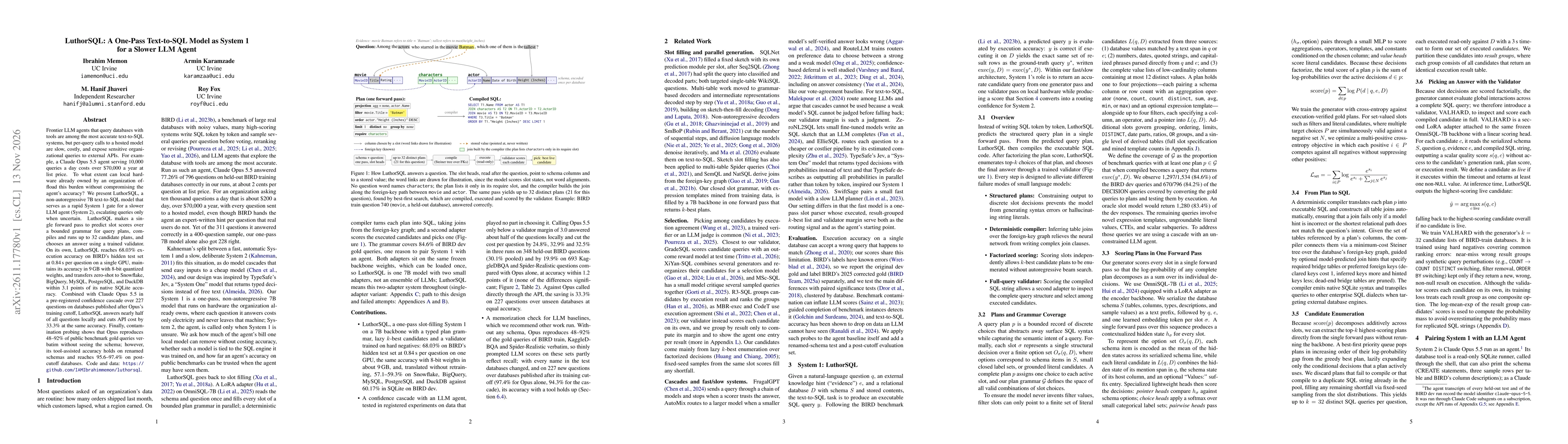
LuthorSQL is a non‑autoregressive 7B text‑to‑SQL model that performs a single forward pass to predict slot scores over a bounded grammar, compiles up to 32 candidate query plans, and selects the best answer using a trained validator. It is used as a fast System 1 gate that escalates queries to a slower LLM agent (System 2) only when its confidence margin is low, forming a confidence cascade.
SignificanceWhy the work matters
The work demonstrates that a locally hosted, fast text‑to‑SQL model can offload a large portion of query processing from expensive external LLM APIs, cutting costs, reducing latency, and preserving data privacy without sacrificing accuracy.
Technical contributionsWhat the work introduces
Introduces a one‑pass slot‑filling architecture with a typed plan grammar, a lightweight validator trained on hard negatives, and a confidence‑based cascade that seamlessly combines a fast local model with a powerful LLM agent.
NoveltyHow it differs from prior work
First non‑autoregressive 7B text‑to‑SQL system designed as a System 1 gate that can operate entirely on local hardware and dynamically defer to a slower LLM agent only when needed.
Future workQuestions that remain
- Expand the plan grammar to increase coverage of complex SQL patterns.
- Explore larger candidate pools or adaptive search strategies to handle harder queries.
- Integrate additional validation signals and extend the cascade to other LLM agents.
Discussion 0