Machine-Learning Reconstruction of Intergalactic Medium Column-Density Maps from Observed Ly$α$ Emission Cubes
Abstract
Understanding the large-scale structure of the intergalactic medium (IGM) is essential for studying galaxy evolution, particularly at $z \sim 2$--$6$, when cold filaments in the cosmic web are considered a primary mechanism for fueling galaxy growth. At these redshifts, Ly$α$ emission shifts into the optical regime and serves as the primary tracer of diffuse IGM for ground-based integral field units (IFUs). However, detections remain limited by low signal-to-noise ratios (S/N) and the complexities of resonant scattering. We present a proof-of-concept machine-learning framework to reconstruct IGM gas column-density maps from noisy Ly$α$ IFU emission cubes. Using Keck Cosmic Web Imager (KCWI) observations of $z \sim 2.3$ protoclusters as a case study, we train a custom convolutional neural network (CNN), the Column Density Estimator (CDE), on a simulated dataset combining IllustrisTNG100 with simplified radiative-transfer calculations and an approximate treatment of KCWI noise. The CDE successfully reconstructs broad filamentary structures in the simulated test set under these adopted assumptions. Applied to observed KCWI data, the CDE predicts gas column-density maps containing filamentary structures extending over $\gtrsim 40''$ ($\sim 1$ comoving Mpc), consistent with an IGM interpretation. The observed reconstructions remain conditional on the adopted models. These results illustrate the potential of the CDE framework for connecting diffuse Ly$α$ observations with simulations of the IGM.
Analysis
AI-generated · verify against the original paper
Generated Jan 1, 0001ResultsWhat the authors found
- The CDE successfully reconstructs broad filamentary structures in the simulated test set under the adopted assumptions.
- When applied to observed KCWI data, the CDE predicts gas column‑density maps showing filamentary structures extending over ≳40'' (~1 comoving Mpc), consistent with an IGM interpretation.
LimitationsWhere the findings need caution
- The reconstructions remain conditional on the adopted simulation and radiative‑transfer models.
- Simplified radiative‑transfer calculations and an approximate treatment of KCWI noise may limit fidelity to real observations.
- Low signal‑to‑noise ratios of Lyα emission introduce uncertainties in the recovered maps.
MethodologyHow the work was done
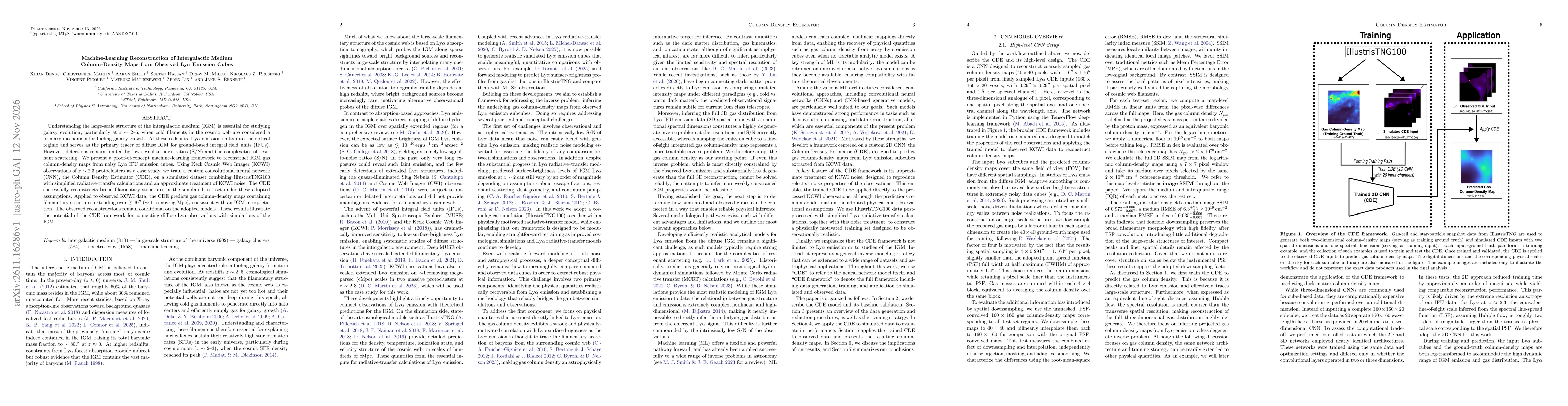
A custom convolutional neural network (CNN) called the Column Density Estimator (CDE) was trained on simulated Lyα emission cubes generated from the IllustrisTNG100 simulation combined with simplified radiative‑transfer calculations and an approximate model of KCWI noise, then applied to real KCWI observations of z~2.3 protoclusters.
SignificanceWhy the work matters
The study demonstrates the feasibility of using machine‑learning to invert noisy Lyα emission observations into IGM column‑density maps, providing a new tool to connect diffuse Lyα observations with cosmological simulations and to probe the cosmic web at high redshift.
Technical contributionsWhat the work introduces
Introduction of the Column Density Estimator (CDE), a CNN architecture tailored to infer IGM gas column‑density maps directly from noisy Lyα IFU cubes, bridging forward modeling and inverse inference.
NoveltyHow it differs from prior work
First proof‑of‑concept demonstration of a machine‑learning inverse mapping from observed Lyα emission cubes to underlying IGM column‑density structures, enabling direct comparison between observations and simulations.
Future workQuestions that remain
- Retrain and refine the CDE with improved cosmological simulations and more sophisticated Lyα radiative‑transfer models.
- Incorporate more realistic noise modeling and observational systematics to enhance reconstruction accuracy.
- Extend the framework to other IFU datasets and higher redshift regimes.
Discussion 0