MAGE: Color-Invariant and Spatial Knowledge Distillation for Gastric Neoplasm Classification
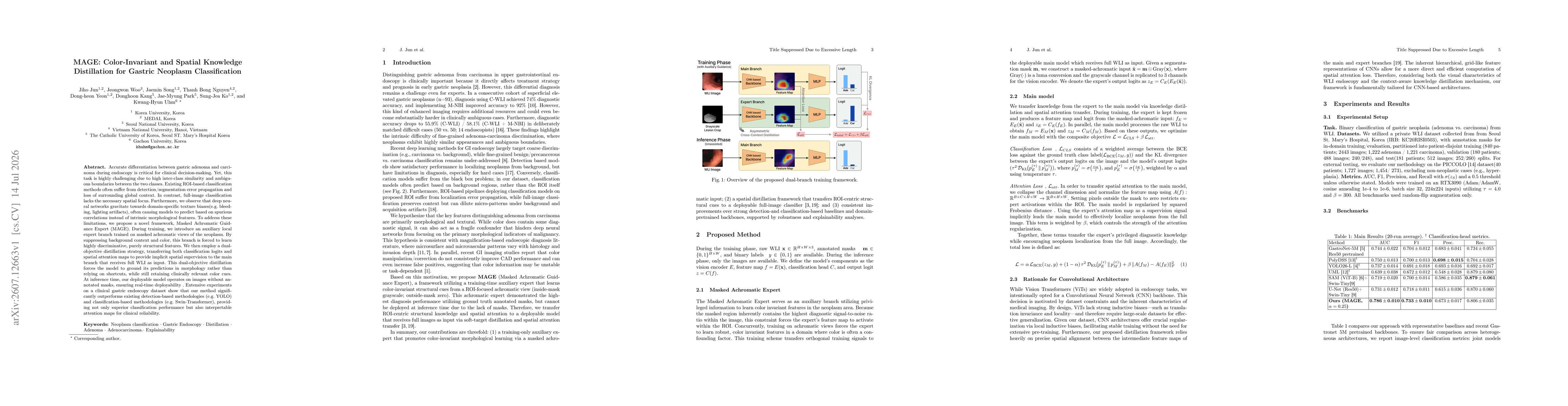
The paper introduces MAGE, a training framework that uses a masked achromatic (color-free) local expert to learn structural features for gastric neoplasm classification, and a dual-objective distillation of both class predictions and spatial attention to guide the main full-image classifier. At inference, the model classifies without masks and achieves superior accuracy and interpretable attention maps compared to existing methods, reducing reliance on spurious color cues and localizing morphology for clinical reliability.
Abstract
Accurate differentiation between gastric adenoma and carcinoma during endoscopy is critical for clinical decision-making. Yet, this task is highly challenging due to high inter-class similarity and ambiguous boundaries between the two classes. Existing ROI-based classification methods often suffer from detection/segmentation error propagation and loss of surrounding global context. In contrast, full-image classification lacks the necessary spatial focus. Furthermore, we observe that deep neural networks gravitate towards domain-specific texture biases(e.g. bleeding, lighting artifacts), often causing models to predict based on spurious correlations instead of intrinsic morphological features. To address these limitations, we propose a novel framework, Masked Achromatic Guidance Expert (MAGE). During training, we introduce an auxiliary local expert branch trained on masked achromatic views of the neoplasm. By suppressing background context and color, this branch is forced to learn highly discriminative, purely structural features. We then employ a dual-objective distillation strategy, transferring both classification logits and spatial attention maps to provide implicit spatial supervision to the main branch that receives full WLI as input. This dual-objective distillation forces the model to ground its predictions in morphology rather than relying on shortcuts, while still retaining clinically relevant color cues. At inference time, our deployable model operates on images without annotated masks, ensuring real-time deployability . Extensive experiments on a clinical gastric endoscopy dataset show that our method significantly outperforms existing detection-based methodologies (e.g. YOLO) and classification-based methodologies (e.g. Swin-Transformer), providing not only superior classification performance but also interpretable attention maps for clinical reliability.
Analysis
AI-generated · verify against the original paper
Generated Jul 16, 2026ResultsWhat the authors found
- The proposed method significantly outperforms existing detection-based methods (e.g., YOLO) and classification-based methods (e.g., Swin-Transformer) on a clinical gastric endoscopy dataset.
- Dual-objective distillation yields superior classification accuracy and provides interpretable attention maps to support clinical reliability.
- Color-invariant, structure-focused learning reduces reliance on spurious color cues while preserving clinically relevant color information for final decisions.
LimitationsWhere the findings need caution
- The study emphasizes classification robustness but does not provide explicit, quantitative localizations; potential localization outputs may rely on post-hoc cues.
- External validation is limited to a single clinical dataset; generalization across centers and devices remains to be established.
- Training-time auxiliary expert requires access to ROI masks, which may not be available in all datasets.
MethodologyHow the work was done
MAGE trains a dual-branch framework where an auxiliary local expert learns color-invariant, achromatic structural features from masked ROI views, while a main branch processes full-color whole-image inputs. A dual-objective distillation transfers both classification logits and spatial attention maps from the auxiliary expert to the main branch, enabling spatial grounding without requiring masks at inference. The auxiliary branch operates on masked grayscale views to suppress background and color, forcing morphology-focused learning; distillation provides implicit spatial supervision to improve localization and robustness. Inference uses the deployable full-image model without masks, enabling real-time application.
SignificanceWhy the work matters
Addresses critical clinical need for accurate gastric neoplasm differentiation by grounding predictions in morphology rather than texture or color shortcuts, while maintaining real-time deployability and providing interpretable spatial attention outputs.
Technical contributionsWhat the work introduces
Introduction of a training-time auxiliary achromatic local expert to enforce color-invariant structural learning, and a dual-objective distillation strategy transferring both logits and spatial attention to a deployable full-image classifier.
NoveltyHow it differs from prior work
First to combine a masked achromatic guidance expert with dual-objective distillation for simultaneous classification and spatial attention transfer in gastric neoplasm classification, achieving color-invariant morphology-focused learning while retaining color cues at inference.
Future workQuestions that remain
- Explore lightweight, CAM-based or weakly supervised localization to derive explicit localizations without full segmentation masks.
- Conduct multi-center, device-diverse external validation to assess generalization and clinical utility.
- Publicly release code and weights to facilitate reproducibility and broader adoption, and investigate extending MAGE to other gastroenterology tasks.
Discussion 0