Magnetic-field-induced parity effect in insulating Josephson junction chains
This paper reports the experimental observation of even-odd parity effects in insulating Josephson junction chains, where the critical voltage for charge transport shows a non-monotonic dependence on applied magnetic fields, indicating a transition from Cooper-pair to single-electron dominated transport. The study reveals distinct transport behaviors at the parity field, providing insights into the insulating peak in disordered superconducting films.
Abstract
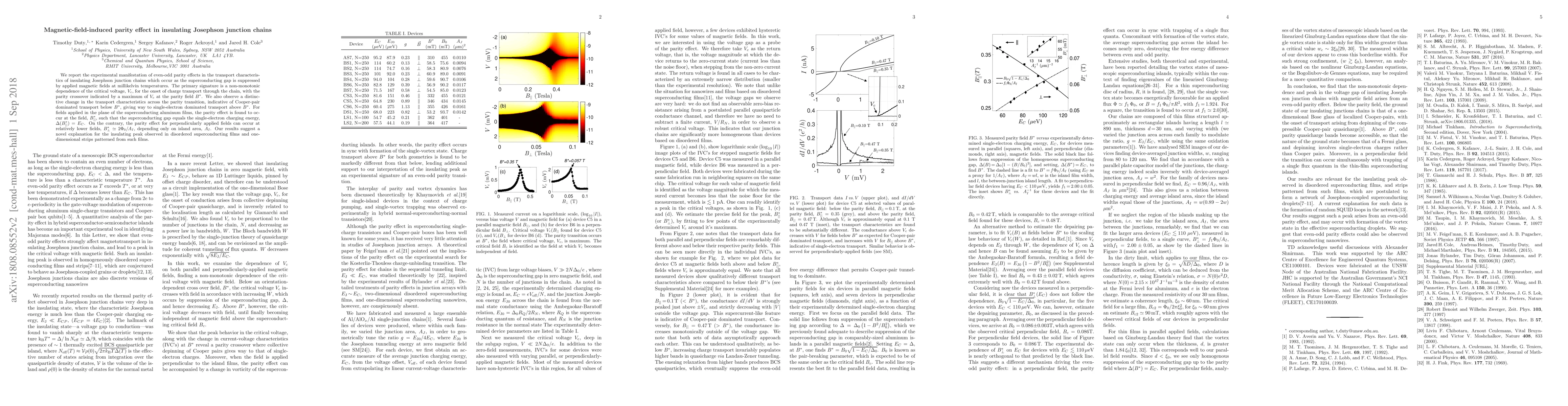
We report the experimental manifestation of even-odd parity effects in the transport characteristics of insulating Josephson junction chains which occur as the superconducting gap is suppressed by applied magnetic fields at millikelvin temperatures. The primary signature is a non-monotonic dependence of the critical voltage, $V_c$, for the onset of charge transport through the chain, with the parity crossover indicated by a maximum of $V_c$ at the parity field $B^*$. We also observe a distinctive change in the transport characteristics across the parity transition, indicative of Cooper-pair dominated transport below $B^*$, giving way to single-electron dominated transport above $B^*$. For fields applied in the plane of the superconducting aluminum films, the parity effect is found to occur at the field, $B^*_{||}$, such that the superconducting gap equals the single-electron charging energy, $\Delta(B^*_{||})=E_C$. On the contrary, the parity effect for perpendicularly applied fields can occur at relatively lower fields, $B^*_\perp\simeq 2\Phi_0/A_I$, depending only on island area, $A_I$. Our results suggest a novel explanation for the insulating peak observed in disordered superconducting films and one-dimensional strips patterned from such films.
AI Key Findings
Get AI-generated insights about this paper's methodology, results, significance, and more — available when analysis has been generated.
Discussion 0