Magnetophotonic crystals with antiferromagnetic order
The paper studies magnetophotonic crystals composed of alternating layers with opposite out-of-plane magnetization, showing that even with zero net magnetization a photonic bandgap and nontrivial topological phases arise. It demonstrates strong cross-polarized light reflection within the gap, enabling magnetically tunable polarization-rotating mirrors and drawing connections to topological photonics and axion electrodynamics.
Abstract
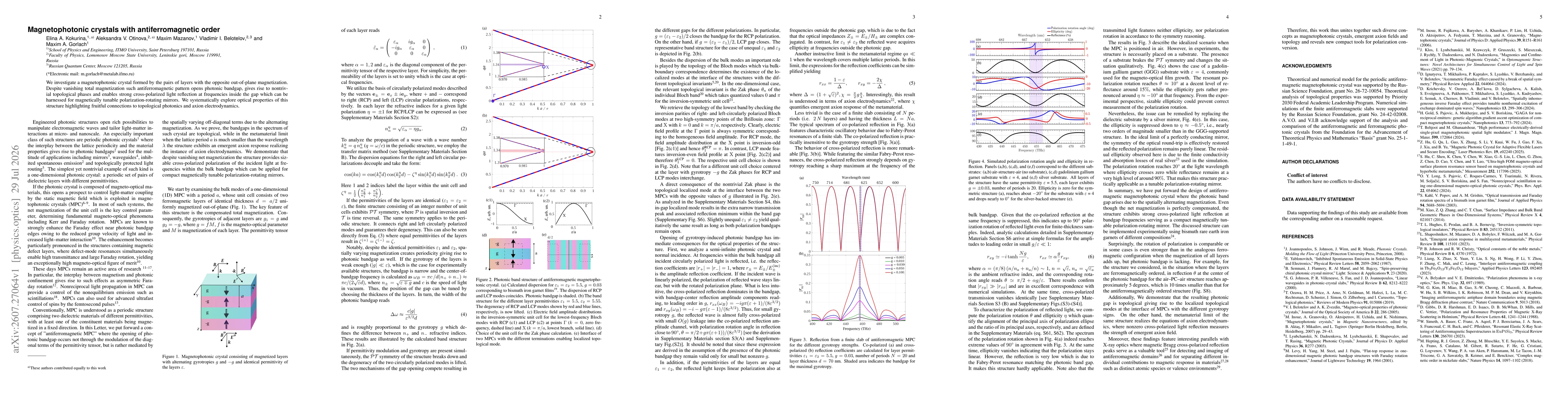
We investigate a magnetophotonic crystal formed by the pairs of layers with the opposite out-of-plane magnetization. Despite vanishing total magnetization such antiferromagnetic pattern opens photonic bandgap, gives rise to nontrivial topological phases and enables strong cross-polarized light reflection at frequencies inside the gap which can be harnessed for magnetically tunable polarization-rotating mirrors. We systematically explore optical properties of this structure highlighting fruitful connections to topological photonics and axion electrodynamics.
Analysis
AI-generated · verify against the original paper
Generated Aug 1, 2026ResultsWhat the authors found
- AFM ordering opens a photonic bandgap without net magnetization by alternating gyrotropy, yielding topological bandgaps and enabling strong cross-polarized reflection within the gap.
- In the AFM case, RCP and LCP modes are degenerate in the symmetric layer case, but the gap persists due to spatially varying magnetization; a gap center rotation angle approaches pi/2 with small corrections depending on ambient impedance.
- In the metamaterial limit with a short lattice period, the structure exhibits an emergent axion response, realizing axion electrodynamics within the photonic system.
- The rotation of polarization in reflection is robust to exterior impedance changes to leading order, with near-π/2 rotation but minor ambient-index–dependent corrections.
- AFM configuration yields stronger magneto-optical effects compared to FM for comparable parameters, making AFM MPCs more effective for polarization-rotating mirror applications.
LimitationsWhere the findings need caution
- Analyses rely on idealized 1D periodic structures; real devices may involve fabrication-induced deviations and material inhomogeneities.
- Superseded by a need for experimental validation of the axion-like response and exact topological invariants in finite-size samples.
MethodologyHow the work was done
The study analyzes a one-dimensional magnetophotonic crystal (MPC) composed of pairs of ferromagnetic layers with opposite out-of-plane magnetization. The authors derive the permittivity tensor for each layer, transform to a circular basis to decouple right/left circular polarizations, and apply a transfer-matrix method to obtain dispersion relations and bandgap conditions. They compare antiferromagnetic (AFM) and ferromagnetic (FM) configurations, compute band structures, and examine polarization reflection, including topological features via Zak phase considerations and axion-electrodynamics implications. The analysis includes both analytical expressions for bandgaps and numerical band structure calculations, supported by supplemental calculations for impedance and polarization rotation corrections.
SignificanceWhy the work matters
Demonstrates a topological, magneto-optical 1D photonic system where antiferromagnetic order enables robust bandgaps and axion-like electrodynamics, providing a route to magnetically tunable polarization-rotating mirrors and deep connections to topological photonics.
Technical contributionsWhat the work introduces
Provides a complete analytical and numerical framework for AFM-ordered 1D MPCs, deriving dispersion relations, gap conditions, and polarization-rotation properties; introduces axion-electrodynamics interpretation in the metamaterial limit; compares AFM and FM configurations to quantify magneto-optical strengths.
NoveltyHow it differs from prior work
Introduces and analyzes the concept of an antiferromagnetically ordered MPC where photonic bandgaps and topological characteristics arise from alternating gyrotropy rather than diagonal permittivity modulation, enabling a topological axion response and robust cross-polarized reflection in a 1D photonic crystal.
Future workQuestions that remain
- Extend to finite-length structures to study edge states and localized topological modes at interfaces between MPCs with different terminations.
- Explore experimental realization with realistic material parameters and assess sensitivity to disorder and thermal fluctuations.
- Investigate dynamic tuning by external magnetic fields or all-optical control to modulate g and ε in real-time.
- Generalize to multi-dimensional MPC architectures to enhance topological protection and control of cross-polarized reflections.
Discussion 0