Making Smell Actionable in Design: Lexicon, Movement Patterns, and Gesture Cards
Abstract
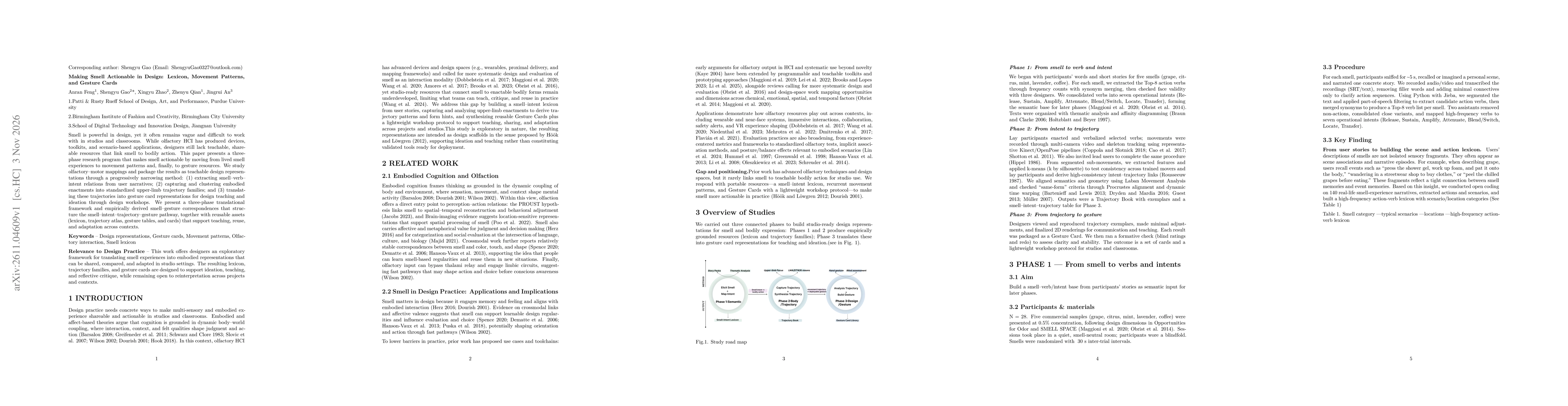
Smell is powerful in design, yet it often remains vague and difficult to work with in studios and classrooms. While olfactory HCI has produced devices, toolkits, and scenario-based applications, designers still lack teachable, shareable resources that link smell to bodily action. This paper presents a three-phase research program that makes smell actionable by moving from lived smell experiences to movement patterns and, finally, to gesture resources. We study olfactory-motor mappings and package the results as teachable design representations through a progressively narrowing method: (1) extracting smell-verb-intent relations from user narratives; (2) capturing and clustering embodied enactments into standardized upper-limb trajectory families; and (3) translating these trajectories into gesture card representations for design teaching and ideation through design workshops. We present a three-phase translational framework and empirically derived smell-gesture correspondences that structure the smell-intent-trajectory-gesture pathway, together with reusable assets (lexicon, trajectory atlas, gesture tables, and cards) that support teaching, reuse, and adaptation across contexts.
AI Key Findings — Failed
The paper source is temporarily unavailable. Please try again later.
Discussion 0