MamBOA: State-Space Architecture for Video Recognition
Abstract
Fine-grained action recognition demands temporal reasoning that general-purpose architectures address through different cost-accuracy tradeoffs: 3D dense operators couple computation to the input volume, while difference-based methods approximate motion through rigid, hand-crafted subtraction of uncontextualized features - each reflecting a deliberate design choice with corresponding limitations in expressiveness or flexibility. We present MamBOA, a backbone-agnostic temporal framework built upon a novel interleaved scan structure that recasts the selective state-space recurrence (S6) as a native motion synthesizer. By interleaving consecutive feature representations extracted from a pretrained backbone into a single alternating sequence, the proposed scan structurally drives the recurrence to encode both temporal observations of each position within a shared hidden state, separated by only a single decay step - rendering the inter-frame transition an intrinsic component of the state dynamics rather than an externally computed quantity. A cascade of dedicated alignment and decoding operations then distills this joint encoding into an explicit motion representation, which a dual-path pooling mechanism adaptively aggregates by balancing attention-driven selection with uniform temporal coverage. The framework interfaces seamlessly with CNN, Transformer, and Mamba backbone families, adding only ~2.1 GFLOPs per feature pair. On Diving48, MamBOA achieves 85.02% Top-1 accuracy with an image-pretrained backbone and 86.24% with a video-pretrained backbone processing the entire video in a single forward pass - demonstrating that structurally induced state-space dynamics constitute a principled and general foundation for motion modeling.
Analysis
AI-generated · verify against the original paper
Generated Jun 16, 2026ResultsWhat the authors found
- On Diving48, MamBOA achieves 85.02% Top-1 accuracy with an image-pretrained backbone and 86.24% Top-1 with a video-pretrained backbone when processing the full video in a single forward pass.
- The temporal head adds only ~2.1 GFLOPs per feature pair, demonstrating high efficiency and compatibility with diverse backbone footprints.
- The results support that state-space differential synthesis can be learned and decoupled from backbone computations, achieving competitive performance with lightweight temporal modeling.
LimitationsWhere the findings need caution
- Evaluations are limited to Diving48; broader validation across additional fine-grained benchmarks and motion statistics remains to be explored.
- Clip-level and full-video processing relies on an adaptive sampling strategy that may require tuning for different datasets or action boundary characteristics.
MethodologyHow the work was done
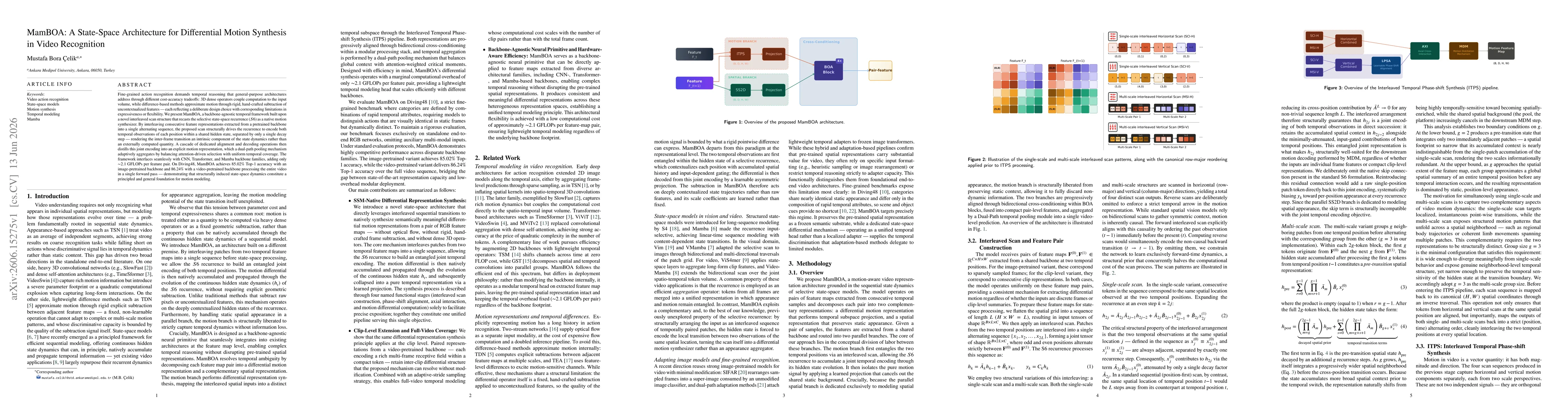
MamBOA introduces a backbone-agnostic temporal framework that interleaves consecutive feature maps from a pretrained backbone into a single alternating sequence to drive the S6 state-space recurrence as a native motion synthesizer. The approach comprises four stages—interleaved scan construction, phase-shift alignment, axial interaction, and motion differential computation—followed by a dual-path pooling mechanism that fuses an explicit differential motion representation with a spatially complementary branch. It operates as a lightweight temporal head (~2.1 GFLOPs per feature-pair) that can be attached to CNN, Transformer, or Mamba backbones, enabling clip-level and full-video coverage through an adaptive clip-based processing strategy.
SignificanceWhy the work matters
The work presents a principled, generalizable foundation for motion modeling in video recognition by synthesizing differential motion directly from interleaved state-space dynamics, enabling backbone-agnostic temporal reasoning with low computational overhead and seamless integration into existing architectures.
Technical contributionsWhat the work introduces
A novel SSM-native differential representation synthesis via Interleaved Temporal Phase-shift Synthesis (ITPS) that fuses interleaved feature-map pairs into a unified temporal encoding, coupled with a dual-path pooling mechanism for adaptive motion-aware aggregation.
NoveltyHow it differs from prior work
Introduces interleaved scan construction to drive state-space recurrence as an intrinsic motion synthesizer, enabling backbone-agnostic, low-cost temporal modeling that integrates with CNN, Transformer, and Mamba backbones without altering pre-trained spatial representations.
Future workQuestions that remain
- Extend MamBOA to long-form, untrimmed video with temporal action segmentation, using a localized windowed variant to preserve per-segment outputs.
- Systematically characterize spatial priors that optimize state-space differential synthesis across backbone families and motion regimes.
Discussion 0