Many Plans at Once: Diverse Top-Quality Planning in Continuous Time
Abstract
Planners for physical systems usually return a single trajectory, which leaves no alternative when an unmodeled constraint invalidates the chosen route or downstream preferences change. A set of plans computed in advance provides ready-made alternatives and warm-starts for fast adaptation, but only if the plans are both low-cost and mutually distinct. Discrete planning addresses this with top-quality and diverse planning, but these ideas do not transfer to continuous time, where every valid trajectory has infinitely many valid near-copies, and existing trajectory planners converge to one or a few solutions. We present Many Plans at Once (MPAO), which treats every plan it finds as a reason to search elsewhere: it samples untrained neural networks whose outputs meet the boundary conditions by construction, trains corrections shared by networks from the same distribution, stores every validated plan, and adapts its sampling to what it has found, which makes it anytime. We define the goal by bringing the cost bound of top-quality planning and the distinctness threshold of diverse planning to continuous time. Under equal budgets against five baselines, MPAO is the only method that solves all 40 instances across four domains. On contact-rich manipulation, it is the only method with plans within 25% of the best known cost on one task, and returns about ten times as many such plans as the strongest baseline on the other two.
Analysis
AI-generated · verify against the original paper
Generated Jan 1, 0001ResultsWhat the authors found
- Under equal computational budgets, MPAO solved all 40 problem instances across four domains, whereas all five baselines failed on at least one instance.
- In contact‑rich manipulation, MPAO was the only method to produce a plan within 25% of the best known cost on one task.
- On two other manipulation tasks, MPAO returned roughly ten times as many plans meeting the same cost bound as the strongest baseline.
MethodologyHow the work was done
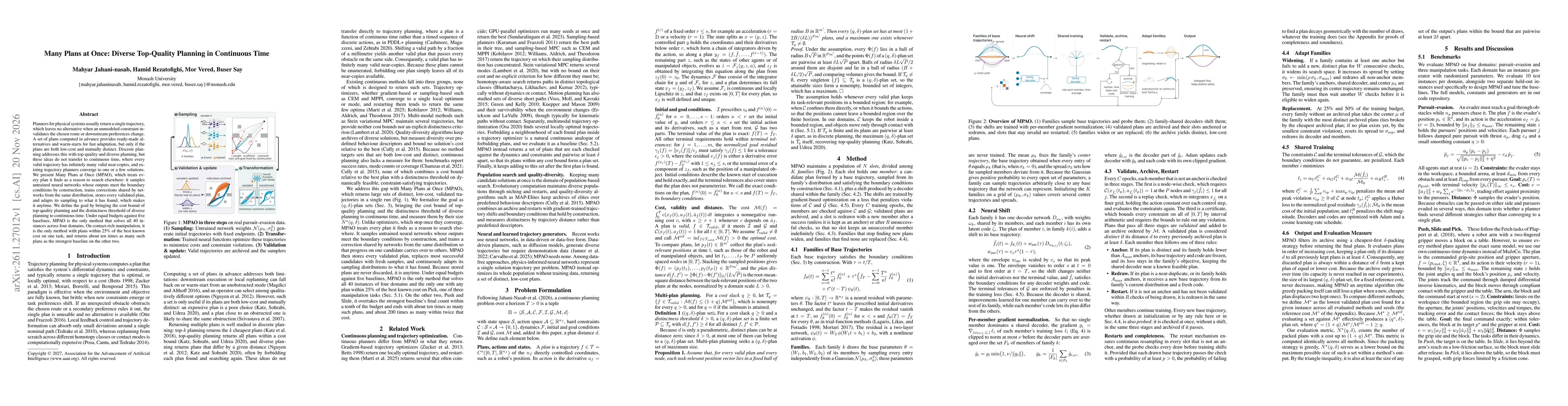
MPAO samples untrained neural networks whose outputs satisfy boundary conditions, trains shared correction networks across samples, validates and archives each low-cost feasible trajectory, and continuously adapts the sampling distributions based on discovered plans to search elsewhere, operating in an anytime fashion.
SignificanceWhy the work matters
The approach provides a set of mutually distinct, low‑cost trajectories in continuous time, enabling rapid replanning and robustness to unforeseen constraints, and establishes a new performance benchmark for diverse top‑quality planning.
Technical contributionsWhat the work introduces
Integration of boundary‑condition‑satisfying neural network sampling with shared correction learning, an archive of validated plans, and adaptive sampling that treats each discovered plan as a cue to explore new regions of the solution space.
NoveltyHow it differs from prior work
First continuous‑time planner that simultaneously guarantees top‑quality (cost‑bounded) and diversity (distinctness) of multiple trajectories without requiring demonstration data.
Discussion 0