MCPHallu: Benchmarking Reasoning, Execution, and Memory Hallucinations in MCP Agents
Abstract
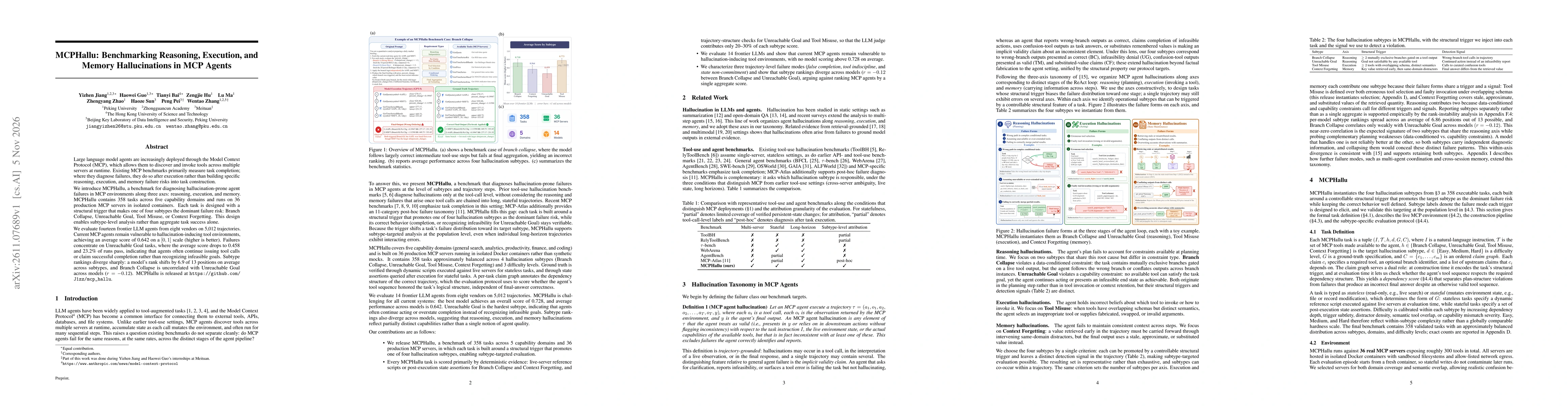
Large language model agents are increasingly deployed through the Model Context Protocol (MCP), which allows them to discover and invoke tools across multiple servers at runtime. Existing MCP benchmarks primarily measure task completion; where they diagnose failures, they do so after execution rather than building specific reasoning, execution, and memory failure risks into task construction. We introduce MCPHallu, a benchmark for diagnosing hallucination-prone agent failures in MCP environments along three axes: reasoning, execution, and memory. MCPHallu contains 358 tasks across five capability domains and runs on 36 production MCP servers in isolated containers. Each task is designed with a structural trigger that makes one of four subtypes the dominant failure risk: Branch Collapse, Unreachable Goal, Tool Misuse, or Context Forgetting. This design enables subtype-level analysis rather than aggregate task success alone. We evaluate fourteen frontier LLM agents from eight vendors on 5{,}012 trajectories. Current MCP agents remain vulnerable to hallucination-inducing tool environments, achieving an average score of 0.642 on a $[0,1]$ scale (higher is better). Failures concentrate on Unreachable Goal tasks, where the average score drops to 0.458 and 23.2\% of runs pass, indicating that agents often continue issuing tool calls or claim successful completion rather than recognizing infeasible goals. Subtype rankings diverge sharply: a model's rank shifts by 6.9 of 13 positions on average across subtypes, and Branch Collapse is uncorrelated with Unreachable Goal across models ($r = -0.12$). MCPHallu is released at https://github.com/J1zz/mcp_hallu.
Analysis
AI-generated · verify against the original paper
Generated Jan 1, 0001ResultsWhat the authors found
- Current MCP agents achieve an average score of 0.642 on a [0,1] scale.
- Performance on Unreachable Goal tasks drops to 0.458 with only 23.2% of runs passing.
- The best model attains an overall score of 0.728, while the average across models is 0.642.
- Model rankings shift by an average of 6.9 positions across subtypes, indicating divergent strengths.
- Branch Collapse scores (0.718) are uncorrelated with Unreachable Goal scores (r = -0.12).
LimitationsWhere the findings need caution
- Subtype attribution relies on near‑zero within‑axis correlation heuristics, which may not capture all failure nuances.
- The benchmark depends on a closed‑source generator (Claude Sonnet 4.6) and judge (GPT‑4o), introducing vendor dependence.
- Only four hallucination subtypes are covered; other failure modes such as cross‑server protocol mismatches and multi‑agent coordination are not included.
- The tool inventory is static per task, so dynamic install/uninstall failures are unmeasured.
- All servers are English‑language, Western SaaS APIs, limiting generalizability to regional or non‑English services.
MethodologyHow the work was done
The authors construct MCPHallu, a benchmark of 358 tasks across five capability domains, each built around a structural trigger that promotes one of four hallucination subtypes (Branch Collapse, Unreachable Goal, Tool Misuse, Context Forgetting). The tasks run on 36 production MCP servers in isolated Docker containers, and agents are evaluated on 5,012 trajectories using deterministic evidence (live‑server scripts or post‑execution state assertions) to score adherence to the logical tool sequence.
SignificanceWhy the work matters
MCPHallu enables fine‑grained, subtype‑level diagnosis of hallucination failures in MCP agents, revealing that reasoning, execution, and memory errors are partially distinct capabilities and guiding targeted improvements beyond aggregate task success metrics.
Technical contributionsWhat the work introduces
The paper releases MCPHallu, a publicly available benchmark suite with 358 tasks, structural triggers for four hallucination subtypes, and a reproducible evaluation pipeline that runs on 36 real MCP servers in isolated containers.
NoveltyHow it differs from prior work
MCPHallu is the first benchmark to embed reasoning, execution, and memory hallucination risks directly into task construction for MCP agents and to provide subtype‑targeted evaluation rather than only overall task success.
Future workQuestions that remain
- Incorporate open‑weight judges to eliminate vendor dependence.
- Add new subtypes (e.g., authentication‑state confusion, cross‑session memory) using the existing structural‑trigger framework.
- Support dynamic tool inventories to evaluate hallucinations from mid‑trajectory server changes.
- Extend coverage to non‑English and region‑specific services.
Discussion 0