Memory-Efficient Parallel Policy Learning for Collapse-Reactive Retreat via Hybrid Terrain Modeling
Abstract
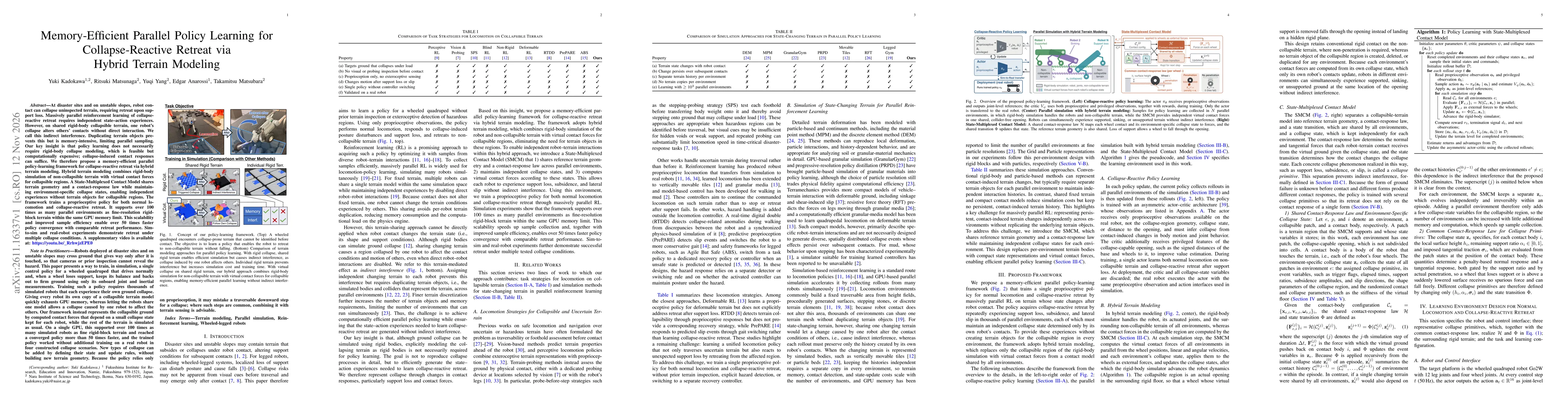
At disaster sites and on unstable slopes, robot contact can collapse uninspected terrain, requiring retreat upon support loss. Massively parallel reinforcement learning of collapse-reactive retreat requires independent state--action experiences. However, on shared rigid-body collapsible terrain, one robot's collapse alters others' contacts without direct interaction. We call this indirect interference. Duplicating terrain objects prevents this but is memory-intensive, limiting parallel sampling. Our key insight is that policy learning does not necessarily require rigid-body collapse modeling, which is feasible but computationally expensive; collapse-induced contact responses can suffice. We therefore propose a memory-efficient parallel policy-learning framework for collapse-reactive retreat via hybrid terrain modeling. Hybrid terrain modeling combines rigid-body simulation of non-collapsible terrain with virtual contact forces for collapsible regions. A State-Multiplexed Contact Model shares terrain geometry and a contact-response law while maintaining environment-specific collapse states, enabling independent experiences without terrain objects for collapsible regions. The framework trains a proprioceptive policy for both normal locomotion and collapse-reactive retreat. It supports over 100 times as many parallel environments as fine-resolution rigid-block terrain within the same GPU memory limit. This scalability and improved sample efficiency enable over 50 times faster policy convergence with comparable retreat performance. Sim-to-sim and real-robot experiments demonstrate retreat under multiple collapse conditions. A supplementary video is available at: https://youtu.be/_RrhwjzEPE0
Analysis
AI-generated · verify against the original paper
Generated Jan 1, 0001ResultsWhat the authors found
- The framework supports over 100× more parallel environments than fine‑resolution rigid‑block terrain within the same GPU memory limit.
- Policy convergence is achieved more than 50× faster while maintaining comparable retreat performance.
- Sim‑to‑sim and real‑robot experiments demonstrate successful collapse‑reactive retreat under multiple collapse conditions.
MethodologyHow the work was done
The paper proposes a memory‑efficient parallel reinforcement‑learning framework that combines rigid‑body simulation for non‑collapsible terrain with virtual contact forces for collapsible regions. A State‑Multiplexed Contact Model (SMCM) shares terrain geometry and a contact‑response law across parallel environments while maintaining independent collapse states for each robot, enabling independent experiences without duplicating terrain objects.
SignificanceWhy the work matters
By eliminating the need to duplicate collapsible terrain objects, the approach dramatically reduces memory consumption, allowing massive parallel simulation that accelerates learning of safe retreat behaviors for robots operating on unstable, uninspected terrain.
Technical contributionsWhat the work introduces
Introduction of a hybrid terrain modeling scheme with a State‑Multiplexed Contact Model that decouples collapse state from shared terrain geometry, enabling memory‑efficient, interference‑free parallel policy learning for collapse‑reactive retreat.
NoveltyHow it differs from prior work
The use of virtual contact forces to model collapsible terrain regions, combined with shared geometry and independent collapse states, is a novel solution to indirect interference in parallel reinforcement learning environments.
Discussion 0