Meta-Homogenization for Knitwear Simulation
This paper introduces meta-homogenization for knitwear simulation, employing a spatially varying homogenization method that models the knitting pattern's complexity. It achieves faster and more realistic simulations by optimizing material properties at volumetric elements and utilizing a GPU-friendly simulator with a novel domain-decomposed subspace solver.
Abstract
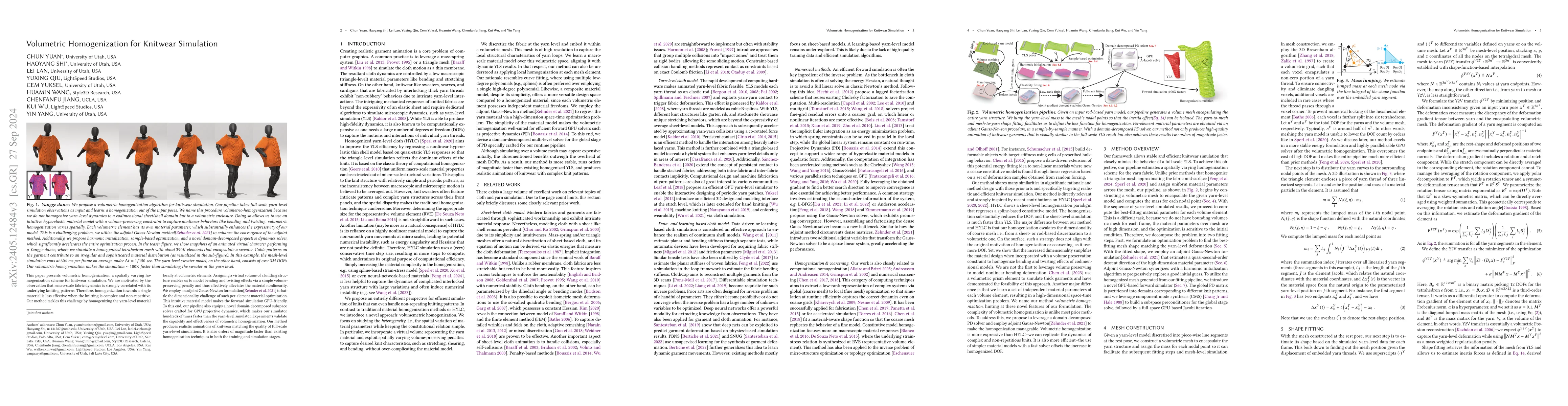
This paper presents meta-homogenization, a spatially varying homogenization scheme for knitwear simulation. We are motivated by the observation that macro-scale fabric dynamics is strongly correlated with its underlying knitting patterns. Therefore, homogenization towards a single material is less effective when the knitting is complex and non-repetitive. Our method tackles this challenge by homogenizing the yarn-level material locally at volumetric elements. Assigning a virtual volume of a knitting structure enables us to model bending and twisting effects via a simple volume-preserving penalty and thus effectively alleviates the material nonlinearity. We employ an adjoint Gauss-Newton formulation to battle the dimensionality challenge of such per-element material optimization. This intuitive material model makes the forward simulation GPU-friendly. To this end, our pipeline also equips a novel domain-decomposed subspace solver crafted for GPU projective dynamics, which makes our simulator hundreds of times faster than the yarn-level simulator. Experiments validate the capability and effectiveness of meta-homogenization. Our method produces realistic animations of knitwear matching the quality of full-scale yarn-level simulations. It is also orders of magnitude faster than existing homogenization techniques in both the training and simulation stages.
AI Key Findings
Get AI-generated insights about this paper's methodology, results, significance, and more — available when analysis has been generated.
Discussion 0