Metamorphic Testing of Learned Spatial Surrogates for Transit Accessibility
Abstract
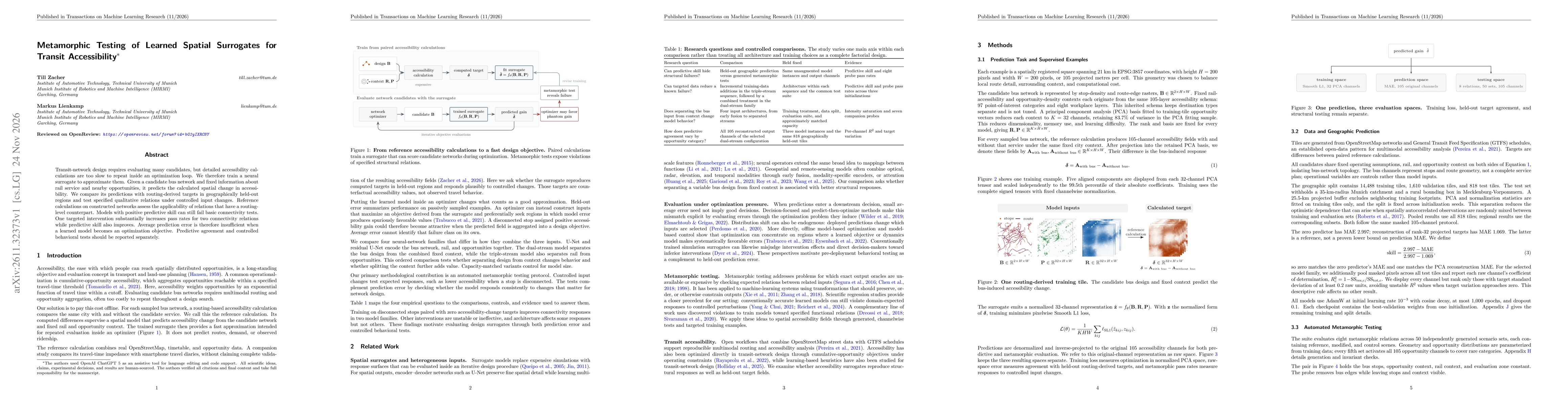
Transit-network design requires evaluating many candidates, but detailed accessibility calculations are too slow to repeat inside an optimization loop. We therefore train a neural surrogate to approximate them. Given a candidate bus network and fixed information about rail service and nearby opportunities, it predicts the calculated spatial change in accessibility. We compare its predictions with routing-derived targets in geographically held-out regions and test specified qualitative relations under controlled input changes. Reference calculations on constructed networks assess the applicability of relations that have a routing-level counterpart. Models with positive predictive skill can still fail basic connectivity tests. One targeted intervention substantially increases pass rates for two connectivity relations while predictive skill also improves. Average prediction error is therefore insufficient when a learned model becomes an optimization objective. Predictive agreement and controlled behavioral tests should be reported separately.
Analysis
AI-generated · verify against the original paper
Generated Jan 1, 0001ResultsWhat the authors found
- Models achieve positive predictive skill (R² up to 0.2 on some channels) but can still fail basic connectivity metamorphic tests.
- A targeted training intervention on disconnected stops substantially increases pass rates for two connectivity relations and also improves overall predictive skill.
- Average prediction error (MAE) alone does not capture failure modes relevant for optimization; predictive agreement and behavioral test outcomes diverge.
LimitationsWhere the findings need caution
- Some interventions are unstable or ineffective, indicating sensitivity to training choices.
- Architectural variations affect certain metamorphic responses but not others, limiting generalizability across model families.
- Evaluation is confined to two geographic regions (Munich and Mecklenburg‑Vorpommern), which may not represent all urban contexts.
MethodologyHow the work was done
The authors train neural network surrogates to predict spatial changes in transit accessibility from candidate bus networks, using paired routing‑based reference calculations as targets. They evaluate four model families (U‑Net, Residual U‑Net, dual‑stream, triple‑stream) on geographically held‑out test tiles and apply an automated metamorphic testing protocol that checks specified qualitative relations under controlled input changes (e.g., disconnecting a stop).
SignificanceWhy the work matters
The study shows that surrogate models for transit accessibility must be evaluated beyond aggregate error metrics, highlighting the importance of metamorphic testing to ensure reliable behavior when the model is used as an optimization objective.
Technical contributionsWhat the work introduces
An automated metamorphic testing protocol that systematically probes learned spatial surrogates for expected qualitative behavior under controlled network modifications, combined with a comparative analysis of multiple neural architectures.
NoveltyHow it differs from prior work
The paper introduces metamorphic testing to the evaluation of learned transit accessibility surrogates, revealing failure modes that are invisible to traditional error metrics and demonstrating that targeted training can simultaneously improve predictive accuracy and behavioral correctness.
Future workQuestions that remain
- Integrate metamorphic testing as a standard evaluation step for learned surrogates in transportation design.
- Explore more robust training interventions to consistently improve connectivity test pass rates across model families.
- Extend the methodology to other transit modes and larger, more diverse urban areas.
Discussion 0