Metric unconditionality and Fourier analysis
This paper examines almost 1-unconditionality and the metric unconditional approximation property (UMAP), revealing singular behavior in translation invariant subspaces $L^p_E(T)$ for even $p$. It constructs counterexamples using arithmetical conditions on sets $E$ and explores the relationship between metric unconditionality and probability theory.
Abstract
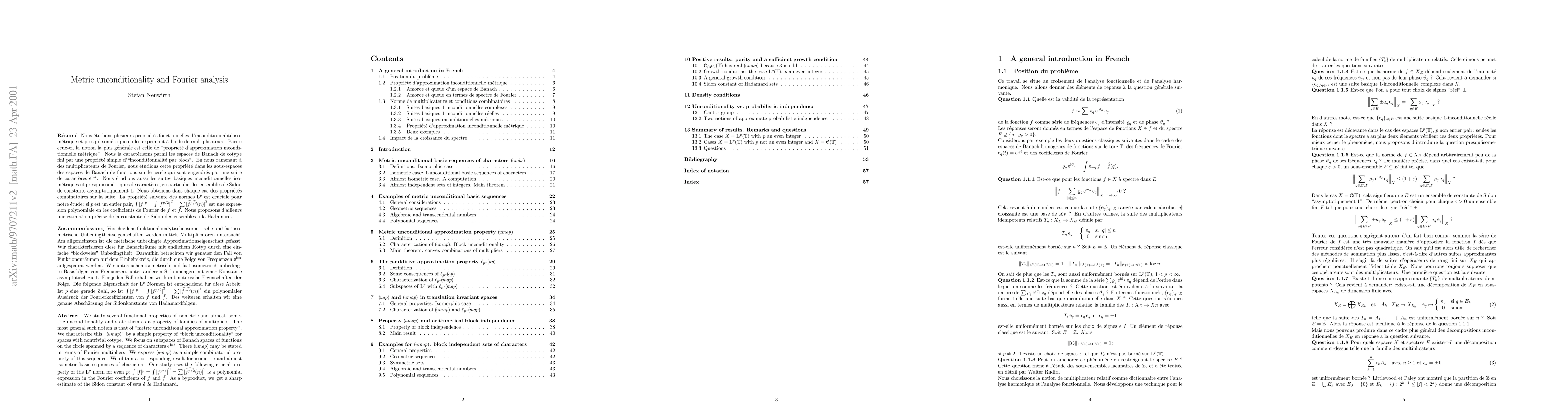
We investigate several aspects of almost 1-unconditionality. We characterize the metric unconditional approximation property UMAP in terms of ``block unconditionality''. Then we focus on translation invariant subspaces $L^p_E(T)$ and $C_E(T)$ of functions on the circle and express block unconditionality as arithmetical conditions on $E$. Our work shows that the spaces $L^p_E(T)$, $p$ an even integer, have a singular behaviour from the almost isometric point of view: property UMAP does not interpolate between spaces $L^p_E(T)$ and $L^{p+2}_E(T)$. These arithmetical conditions are used to construct counterexamples for several natural questions and to investigate the maximal density of such sets $E$. We also prove that if $E=\{n_k\}_{k\ge1}$ with $|n_{k+1}/n_k|\to\infty$, then $C_E(T)$ has UMAP and we get a sharp estimate of the Sidon constant of Hadamard sets. Finally, we investigate the relationship of metric unconditionality and probability theory.
Analysis
AI-generated · verify against the original paper
Generated Sep 2, 2025ResultsWhat the authors found
- Characterization of the metric unconditional approximation property (UMAP) in terms of block unconditionality for Lp_E(T) spaces, where p is an even integer.
- Demonstration that UMAP does not interpolate between Lp_E(T) and L^(p+2)_E(T) for even p, leading to singular behavior from an almost isometric point of view.
- Construction of counterexamples using arithmetical conditions on E to investigate the maximal density of such sets E.
- Proof that if E = {n_k}_{k≥1} with |n_(k+1)/n_k| → ∞, then C_E(T) has UMAP and a sharp estimate of the Sidon constant of Hadamard sets.
- Exploration of the relationship between metric unconditionality and probability theory.
LimitationsWhere the findings need caution
- The findings primarily focus on even integer values of p, leaving the behavior of spaces for non-even integers unexplored.
- The study does not provide explicit examples of sets E for which Lp_E(T) fails UMAP when p is not an even integer.
MethodologyHow the work was done
The paper employs Fourier analysis and metric unconditional approximation properties to investigate translation-invariant subspaces of Lp(T) spaces, utilizing block unconditionality and arithmetical conditions.
SignificanceWhy the work matters
This research contributes to the understanding of the structural properties of function spaces on the circle, with implications for harmonic analysis and the study of translation-invariant subspaces.
Technical contributionsWhat the work introduces
The paper introduces a characterization of UMAP in terms of block unconditionality and provides conditions for translation-invariant subspaces of Lp(T) to have this property.
NoveltyHow it differs from prior work
The work extends the understanding of unconditional approximation properties by linking them to block unconditionality and arithmetical conditions, offering a novel perspective on the structure of Lp(T) spaces.
Future workQuestions that remain
- Investigate the UMAP properties for non-even integer values of p in Lp_E(T) spaces.
- Explore specific examples of sets E for which Lp_E(T) fails UMAP when p is not an even integer.
- Further examine the relationship between metric unconditionality and probability theory.
Discussion 0