Migrating Knowledge between Physical Scenarios based on Artificial Neural Networks
Abstract
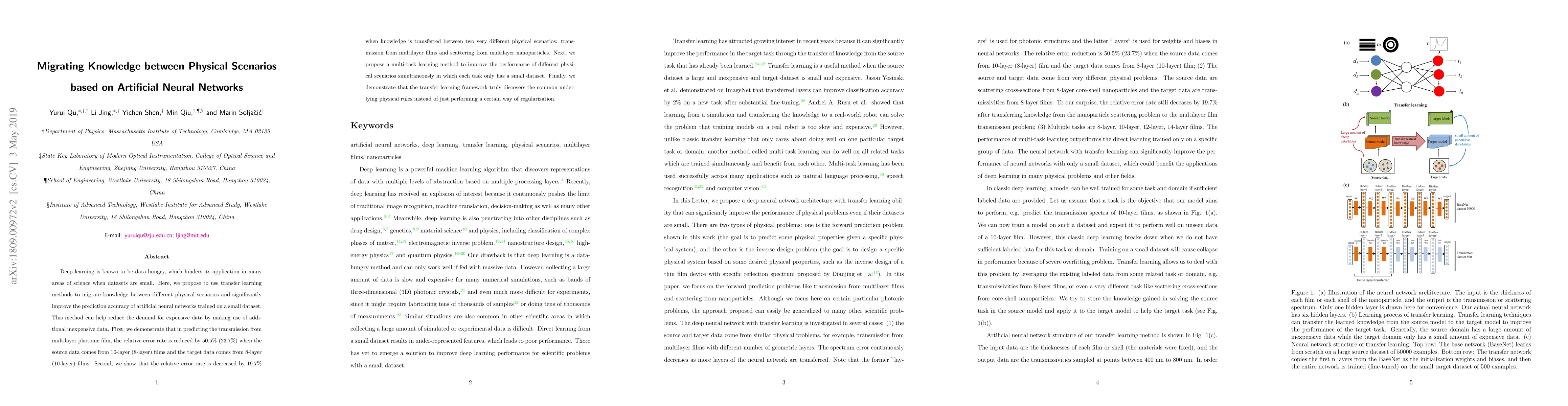
Deep learning is known to be data-hungry, which hinders its application in many areas of science when datasets are small. Here, we propose to use transfer learning methods to migrate knowledge between different physical scenarios and significantly improve the prediction accuracy of artificial neural networks trained on a small dataset. This method can help reduce the demand for expensive data by making use of additional inexpensive data. First, we demonstrate that in predicting the transmission from multilayer photonic film, the relative error rate is reduced by 46.8% (26.5%) when the source data comes from 10-layer (8-layer) films and the target data comes from 8-layer (10-layer) films. Second, we show that the relative error rate is decreased by 22% when knowledge is transferred between two very different physical scenarios: transmission from multilayer films and scattering from multilayer nanoparticles. Finally, we propose a multi-task learning method to improve the performance of different physical scenarios simultaneously in which each task only has a small dataset.
AI Key Findings
Get AI-generated insights about this paper's methodology, results, significance, and more — available when analysis has been generated.
Discussion 0