MixMoMo: Accelerating Extra--Large MoE Inference with Mixed--Precision GPU--NPU Execution on Mobile Devices
Abstract
Mobile agents and on-device intelligence increasingly demand more capable models on smartphones. Through sparse expert activation, Mixture-of-Experts (MoE) scales model capacity, yet growing numbers of fine-grained experts complicate loading and computation. Model compression complements expert offloading by reducing storage and computation costs. Among compression techniques, mixed-precision quantization assigns lower expert bitwidths to balance model quality and inference efficiency. However, existing offline metrics and routing scores fail to reflect expert quantization sensitivity, undermining precision assignment. Diverse bitwidths also complicate balanced expert allocation across GPUs and NPUs with distinct execution characteristics, while tile-wise dequantization underutilizes NPU vector parallelism. We present MixMoMo, an efficient mixed-precision inference runtime for extra-large MoE models on heterogeneous mobile SoCs. MixMoMo combines offline quantization-impact profiles with activation-based runtime risk estimates for quality-constrained expert bitwidth assignment. It further adopts precision-structured execution for balanced GPU-NPU expert allocation and HVX-parallel dequantization for efficient NPU vector utilization. Across three MoE models and five benchmarks on two mobile platforms, MixMoMo achieves average decoding speedups of 3.72x over uniform Q4_0 and 1.53x over the strongest mixed-precision MoE baseline.
Analysis
AI-generated · verify against the original paper
Generated Jan 1, 0001ResultsWhat the authors found
- Achieves average decoding speedups of 3.72× over uniform Q4_0 and 1.53× over the strongest mixed-precision MoE baseline.
- Maintains near‑FP16 model quality with minimal accuracy degradation across three MoE models.
- Ablation shows Quality‑Constrained Precision Assignment adds negligible TPOT change, Precision‑Structured Expert Allocation reduces TPOT by 56.27%, and Cross‑Tile Parallel Dequantization further reduces TPOT by 35.72%.
LimitationsWhere the findings need caution
- Evaluation is limited to three MoE models and five benchmarks on two Snapdragon platforms.
- Method relies on observed correlation between activation magnitudes and quantization sensitivity, which may not generalize to all models or hardware.
MethodologyHow the work was done
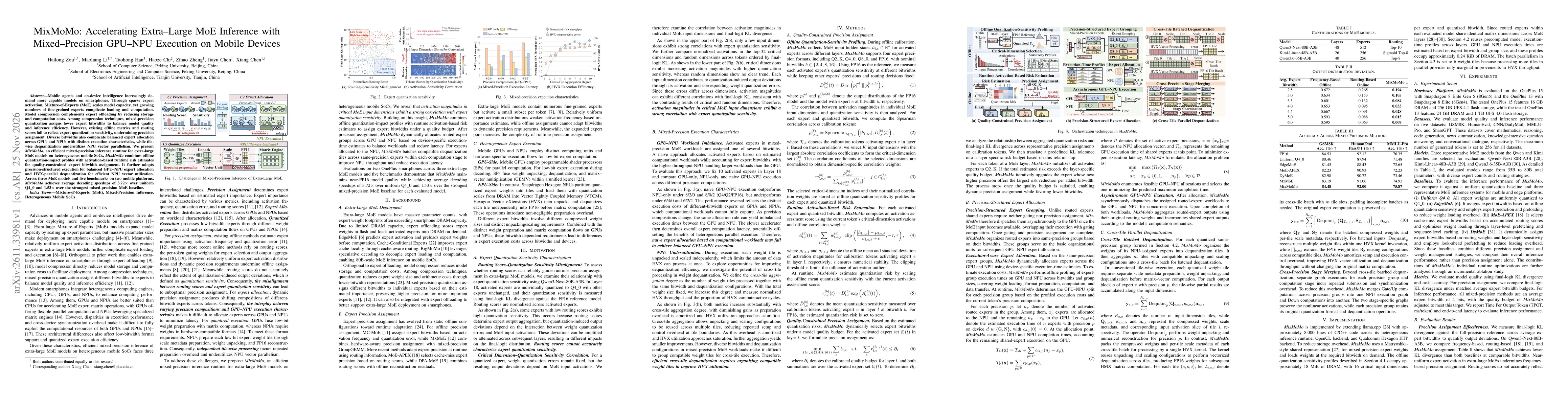
MixMoMo combines offline quantization-impact profiles with activation-based runtime risk estimates for quality-constrained expert bitwidth assignment, employs precision-structured expert allocation across GPU and NPU to balance workloads, and uses HVX-parallel dequantization to improve NPU vector utilization.
SignificanceWhy the work matters
Enables efficient mixed‑precision inference of extra‑large Mixture‑of‑Experts models on heterogeneous mobile SoCs by fully exploiting GPU and NPU resources, reducing latency and storage while preserving model quality.
Technical contributionsWhat the work introduces
Introduces a runtime that jointly optimizes precision assignment, heterogeneous expert allocation, and vector‑parallel dequantization for mixed‑precision MoE inference on mobile devices.
NoveltyHow it differs from prior work
First system to integrate activation‑based quantization risk estimation with precision‑structured GPU‑NPU co‑execution and HVX‑parallel dequantization for extra‑large MoE models on smartphones.
Future workQuestions that remain
- Extend MixMoMo to additional mobile hardware architectures beyond Snapdragon GPUs and NPUs.
- Investigate adaptive runtime strategies for dynamic workload changes and larger expert pools.
Discussion 0