MMUSV-Sim: A Maritime Simulation Platform for Multi-USV Cooperative Perception
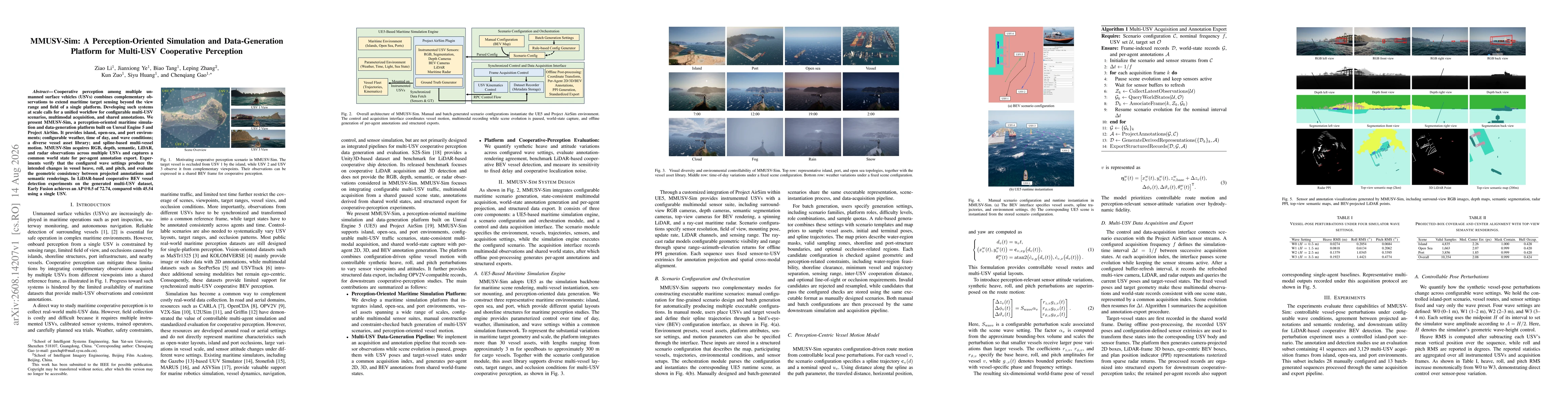
MMUSV-Sim is a Unreal Engine-based platform for simulating and generating data for cooperative perception among multiple USVs, offering diverse environments, weather, waves, assets, and multi-vehicle motion with synchronized multi-sensor outputs. In LiDAR-based experiments, the Early Fusion fusion method on the generated multi-USV data achieved higher accuracy ([email protected] = 72.74) than a single-USV setup (45.54), demonstrating the benefits of shared observations for maritime vessel detection.
Abstract
Perception from a single unmanned surface vehicle (USV) is limited by sensing range, field of view, and occlusions caused by islands, port infrastructure, and nearby vessels. Multi-USV cooperative perception can alleviate these limitations by integrating complementary observations from distributed viewpoints. However, progress is constrained by the high cost of coordinated sea trials, the scarcity of multi-USV datasets, and the lack of integrated maritime simulation and evaluation tools. We present MMUSV-Sim, a perception-oriented maritime simulation and data-generation platform built on Unreal Engine 5 and Project AirSim. It supports configurable maritime scenarios, synchronized multimodal acquisition across multiple USVs, and consistent 3D annotations in a shared world frame. Using MMUSV-Sim, we construct MarU2U-200m, a synchronized multi-USV RGB--LiDAR dataset with 341 sequences and 14,385 scene frames. We establish a cooperative bird's-eye-view (BEV) vessel detection benchmark with LiDAR and RGB--LiDAR inputs. Experimental results show that Early Fusion improves LiDAR detection [email protected] from 64.26 to 81.46 compared with the single-USV baseline. RGB features further improve intermediate fusion, increasing [email protected] by up to 4.55 percentage points. LiDAR and RGB transfer experiments also show the value of the generated data as a pretraining source for real maritime detection. The project are available at https://github.com/lizaowo/MMUSV-Sim
Analysis
AI-generated · verify against the original paper
Generated Aug 18, 2026ResultsWhat the authors found
- Early Fusion achieves [email protected] of 72.74 on LiDAR-based cooperative BEV vessel detection, outperforming the single-USV baseline of 45.54 (Late Fusion achieved 55.47).
- Geometric consistency between projected annotations and semantic renderings is high, with a median center error of 2.08 pixels and mean mask containment of 0.999 across 10,354 valid projections.
- Annotation hull occupancy is 0.424 on average, indicating reasonable alignment between enclosing hulls and rendered vessel silhouettes.
- Performance degrades gracefully under fixed delays; at 600 ms delay, Early Fusion retains [email protected] of 58.06, still above the No Fusion baseline by over 12 points.
- Under pose/noise perturbations, Early Fusion maintains superior [email protected] (63.64) compared to Late Fusion (46.94) and No Fusion (55.47) in clean conditions, demonstrating robustness to moderate sensor perturbations.
LimitationsWhere the findings need caution
- Evaluation focuses on LiDAR-based BEV detection; broader multimodal fusion performance (RGB/depth/semantic/radar) is not exhaustively quantified.
- Simulation-based results may not fully capture real-world sensor noise and calibration errors across diverse maritime environments.
- Per-vessel occlusion patterns and wave dynamics, while parameterized, may not cover all edge-case maritime scenarios encountered in practice.
MethodologyHow the work was done
MMUSV-Sim is built on Unreal Engine 5 and Project AirSim to create configurable maritime environments (island, open sea, port) with variable weather, time of day, and wave settings. It supports a diverse vessel asset library and spline-based multi-vessel motion, enabling synchronized multi-USV data acquisition (RGB, depth, semantic, LiDAR, radar) and a common world state for per-agent annotation export. A three-component system (UE5 maritime simulation engine, scenario configuration/orchestration, and control/data acquisition interface) orchestrates scenario generation, synchronized multimodal data capture, and offline post-processing to generate per-agent 2D/3D/BEV annotations and OPV2V-compatible exports. Evaluation includes geometric-consistency checks between projected annotations and semantic renderings, and LiDAR-based cooperative BEV detection experiments comparing Early Fusion, Late Fusion, and No Fusion baselines across controlled wave-induced pose variations and sensor noises.
SignificanceWhy the work matters
Demonstrates a scalable, perception-oriented maritime simulation and data-generation platform capable of producing synchronized multi-USV multimodal datasets with consistent per-agent annotations, enabling robust evaluation of cooperative perception methods in realistic open-water scenarios.
Technical contributionsWhat the work introduces
A unified UE5 + Project AirSim-based maritime simulation and data-generation platform (MMUSV-Sim) enabling configurable multi-USV scenarios, synchronized multimodal sensing, per-agent world-state annotations, and standardized exports for cooperative perception research.
NoveltyHow it differs from prior work
Introduces a perception-oriented maritime simulation framework with island/open-sea/port environments, spline-based multi-vessel motion, and a synchronized data acquisition/export pipeline that supports per-agent 2D/3D/BEV annotations and OPV2V-compatible data, addressing the lack of realistic, multi-USV annotated maritime datasets.
Future workQuestions that remain
- Extend evaluation to multi-class cooperative perception scenarios and integrate other detectors beyond CenterPoint for baseline diversity.
- Incorporate real-world sensor calibration pipelines to further close sim-to-real gaps and study calibration-related annotation consistency.
- Develop automated scenario generation to systematically explore extreme occlusions, dense traffic, and challenging weather/wave conditions.
Discussion 0