Modeling and Performance Analysis for Fluid Antenna System Enabled UAV Near-Field Communications
The paper develops a dynamic, port-reconfigurable near-field channel model for fluid antenna systems (FAS) used in UAV-to-mobile user links, integrating UAV motion with FAS port activation to capture realistic near-field behavior. It also proposes a greedy subarray partitioning scheme and a high-gain port selection strategy to reduce complexity, improve capacity, and ensure robust performance across FAS size, port spacing, and UAV dynamics.
Abstract
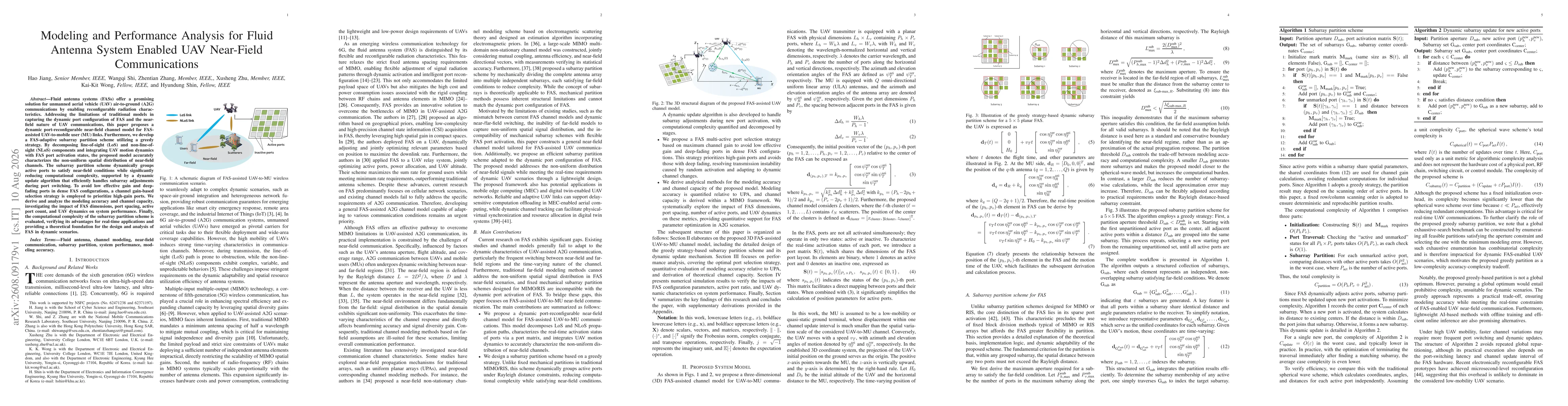
Fluid antenna systems (FASs) offer a promising solution for unmanned aerial vehicle (UAV) air-to-ground (A2G) communications by enabling reconfigurable radiation characteristics. Addressing the limitations of traditional models in capturing the dynamic port configuration of FAS and the near-field nature of UAV communications, this paper proposes a dynamic port-reconfigurable near-field channel model for FAS-assisted UAV-to-mobile user (MU) links. Furthermore, we develop a FAS-adaptive subarray partition scheme utilizing a greedy strategy. By decomposing line-of-sight (LoS) and non-line-of-sight (NLoS) components and integrating UAV motion dynamics with FAS port activation states, the proposed model accurately characterizes the non-uniform spatial distribution of near-field channels. The subarray partition scheme dynamically groups active ports to satisfy near-field conditions while significantly reducing computational complexity, supported by a dynamic update algorithm that efficiently handles subarray adjustments during port switching. To avoid low effective gain and deep-fading ports in dense FAS configurations, a channel gain-based selection strategy is employed to prioritize high-gain ports. We derive and analyze the modeling accuracy and channel capacity, investigating the impact of FAS dimensions, port spacing, active port count, and UAV dynamics on system performance. Finally, the computational complexity of the subarray partition scheme is evaluated, verifying its advantages for real-time applications and providing a theoretical foundation for the design and analysis of FAS in dynamic scenarios.
AI Key Findings
Get AI-generated insights about this paper's methodology, results, significance, and more — available when analysis has been generated.
Discussion 0