Modeling Dynamic Mixtures of Time-Delay Systems from Streaming Time Series
The paper presents DelayMix, an online framework that treats streaming time series as dynamic mixtures of time-delay systems to adapt quickly to regime shifts while using fixed-length memory. By building a summary system tensor from Markov parameters and applying tensor decomposition, the method robustly tracks changing dynamics and delays, delivering faster adaptation and higher forecast accuracy on non-stationary data compared to existing approaches.
Abstract
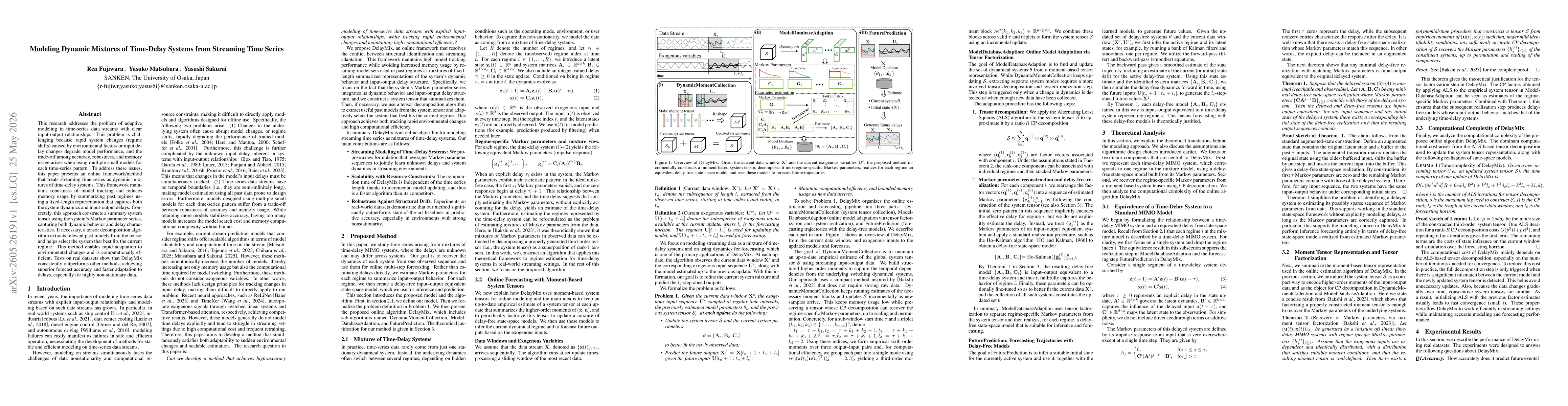
This research addresses the problem of adaptive modeling in time-series data streams with clear input-output relationships. This problem is challenging because rapid system changes (regime shifts) caused by environmental factors or input delay changes degrade model performance, and the trade-off among accuracy, robustness, and memory usage arises when using multiple small models for each time-series pattern. To address these issues, this paper presents an online framework/method that treats streaming time series as dynamic mixtures of time-delay systems. This framework maintains robustness of model tracking and reduces memory usage by summarizing past regimes using a fixed-length representation that captures both the system dynamics and input-output delays. Concretely, this approach constructs a summary system tensor using the system's Markov parameter series, capturing both dynamic behavior and delay characteristics. If necessary, a tensor decomposition algorithm extracts relevant past models from the tensor and helps select the system that best fits the current regime. This method enables rapid adaptation to environmental changes and is computationally efficient. Tests on real datasets show that DelayMix consistently outperforms other methods, achieving superior forecast accuracy and faster adaptation to delays, especially for highly non-stationary data.
AI Key Findings
Get AI-generated insights about this paper's methodology, results, significance, and more — available when analysis has been generated.
Discussion 0