Modeling The Intensity Function Of Point Process Via Recurrent Neural Networks
Researchers develop a new method for modeling point processes using Recurrent Neural Networks to capture background and history effects, offering a flexible and powerful approach for event sequence analysis.
Abstract
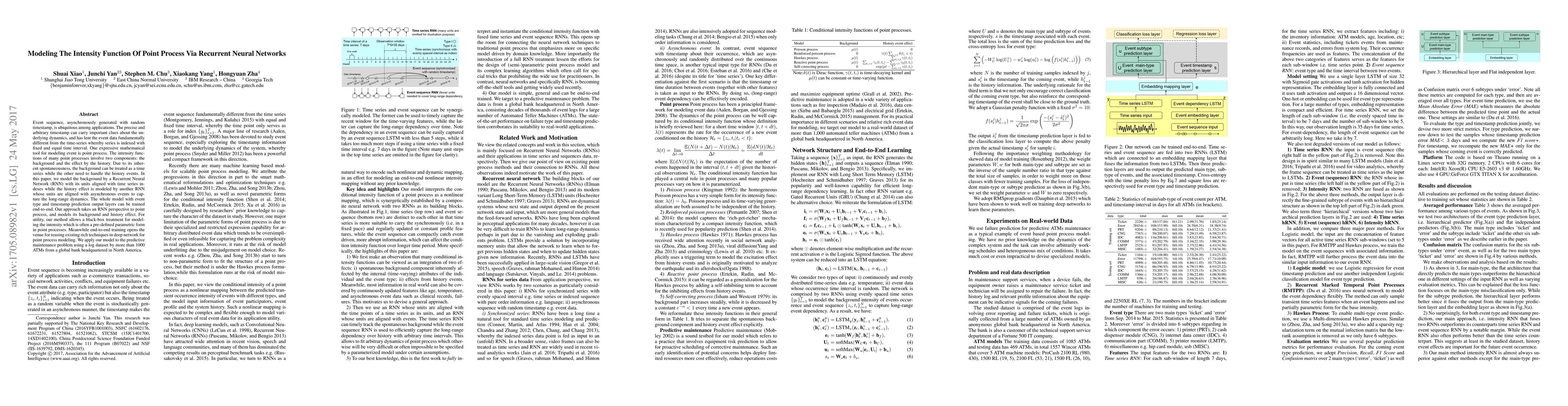
Event sequence, asynchronously generated with random timestamp, is ubiquitous among applications. The precise and arbitrary timestamp can carry important clues about the underlying dynamics, and has lent the event data fundamentally different from the time-series whereby series is indexed with fixed and equal time interval. One expressive mathematical tool for modeling event is point process. The intensity functions of many point processes involve two components: the background and the effect by the history. Due to its inherent spontaneousness, the background can be treated as a time series while the other need to handle the history events. In this paper, we model the background by a Recurrent Neural Network (RNN) with its units aligned with time series indexes while the history effect is modeled by another RNN whose units are aligned with asynchronous events to capture the long-range dynamics. The whole model with event type and timestamp prediction output layers can be trained end-to-end. Our approach takes an RNN perspective to point process, and models its background and history effect. For utility, our method allows a black-box treatment for modeling the intensity which is often a pre-defined parametric form in point processes. Meanwhile end-to-end training opens the venue for reusing existing rich techniques in deep network for point process modeling. We apply our model to the predictive maintenance problem using a log dataset by more than 1000 ATMs from a global bank headquartered in North America.
AI Key Findings
Get AI-generated insights about this paper's methodology, results, significance, and more — available when analysis has been generated.
Discussion 0