Modelling the human-exoskeleton interaction interface - Benchmarking MuJoCo's deformable model
Abstract
The human-exoskeleton interaction interface, consisting of the exoskeleton attachment and the underlying human soft tissue, can affect the transfer of assistance. MuJoCo's \textit{flexcomp} has been previously used to model the soft tissue, but its accuracy has not been benchmarked against a finite element model. We benchmarked the \textit{flexcomp} Saint Venant-Kirchhoff (StVK) and Stable Neo-Hookean (SNH) models against COMSOL's Yeoh model in three cases: \textit{case 1}) spherical indentation, \textit{case 2}) compression, and \textit{case 3}) compression of a thigh. We compared force and strain energy as a function of indentation depth, hysteresis and computation time. MuJoCo's models capture force trends with a correlation of 0.97-0.99, but showed a stiffer response, which could be attributed to the volumetric locking of the linear finite elements. The MuJoCo models systematically underestimated hysteresis as MuJoCo's Rayleigh damping could not substitute a viscoelastic model. Moreover, MuJoCo's computational advantage was speed dependent: it was 2-2.5 times faster for spherical indentation, but COMSOL was faster for the other cases, which have more degrees of freedom and contacts. Although MuJoCo's \textit{flexcomp} offers a combination of soft-tissue modelling and multibody dynamics, the limitations regarding the stiffening and hysteresis should be addressed to be used for the analysis of the human-exoskeleton interaction interface.
Analysis
AI-generated · verify against the original paper
Generated Jan 1, 0001ResultsWhat the authors found
- Force trends from MuJoCo matched COMSOL with correlation coefficients of 0.97–0.99.
- MuJoCo models exhibited a stiffer response, attributed to volumetric locking of linear finite elements.
- Hysteresis was systematically underestimated because MuJoCo's Rayleigh damping cannot replace a viscoelastic model.
- Computation time was 2–2.5× faster for spherical indentation, but slower for the compression cases with higher DOFs and contacts.
LimitationsWhere the findings need caution
- Stiffening due to volumetric locking in linear FEM elements.
- Inadequate hysteresis modeling because of reliance on Rayleigh damping.
- Computational advantage is case‑dependent and diminishes for complex contact scenarios.
MethodologyHow the work was done
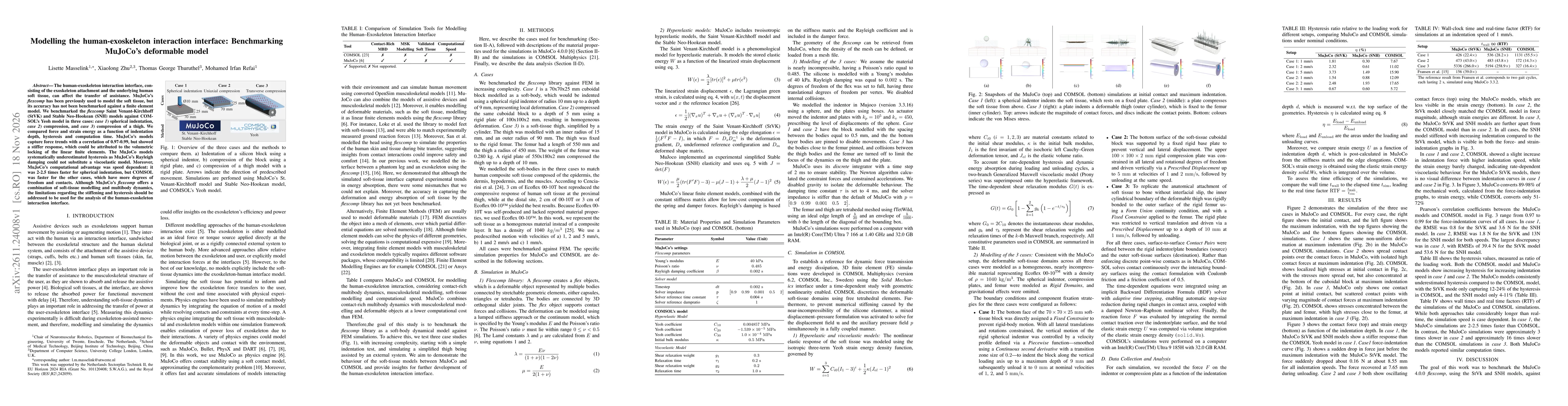
The authors benchmarked MuJoCo's flexcomp Saint Venant‑Kirchhoff (StVK) and Stable Neo‑Hookean (SNH) models against COMSOL's Yeoh finite element model across three test cases (spherical indentation, uniaxial compression, and thigh compression). They compared force‑displacement curves, strain energy, hysteresis, and computation time, using identical material properties and motion profiles.
SignificanceWhy the work matters
The study demonstrates that MuJoCo's flexcomp can capture soft‑tissue force trends while offering integrated multibody dynamics, highlighting its potential for rapid simulation of human‑exoskeleton interfaces despite noted accuracy gaps.
Technical contributionsWhat the work introduces
Provides the first systematic benchmark of MuJoCo's flexcomp deformable body model against a high‑fidelity finite element reference for human‑exoskeleton interaction analysis.
NoveltyHow it differs from prior work
Introduces a quantitative comparison of MuJoCo's soft‑tissue modeling with FEM, revealing both strengths and specific deficiencies for exoskeleton interface simulations.
Future workQuestions that remain
- Address stiffening and hysteresis limitations in MuJoCo's deformable model.
- Calibrate MuJoCo parameters against experimental or FEM data to improve fidelity.
- Extend benchmarking to anatomically realistic geometries such as full thigh and shank models.
Discussion 0