The study tests a family of modified cosmologies built from a mass-to-horizon relation, constraining a temperature-entropy linkage and three key parameters (entropy exponent m, MHR coupling γ, and entanglement correction f_B) using diverse cosmological data. While allowing some increases in the Hubble constant and partial relief of the H0 tension, Bayesian analysis shows these extensions do not improve the overall fit enough to beat ΛCDM across datasets.
Abstract
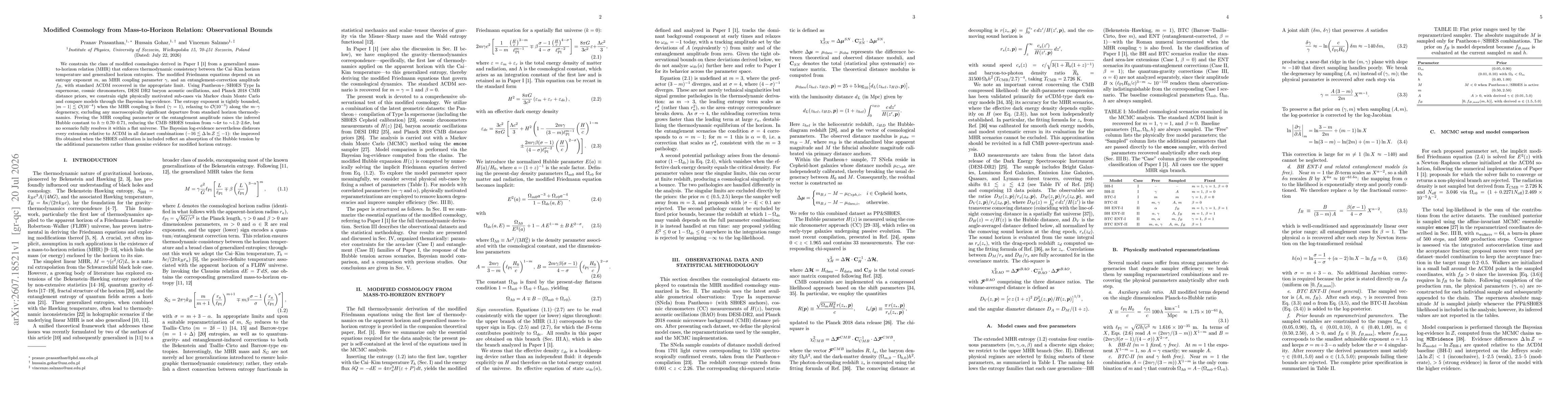
We constrain the class of modified cosmologies derived in Paper I [1] from a generalized mass-to-horizon relation (MHR) that enforces thermodynamic consistency between the Cai-Kim horizon temperature and generalized horizon entropies. The modified Friedmann equations depend on an entropy exponent $m$, an MHR coupling parameter $γ$, and an entanglement-correction amplitude $f_B$, with standard $Λ$CDM recovered in the appropriate limit. Using Pantheon$+$/SH0ES Type~Ia supernovae, cosmic chronometers, DESI DR2 baryon acoustic oscillations, and Planck 2018 CMB distance priors, we constrain eight physically motivated sub-cases via Markov chain Monte Carlo and compare models through the Bayesian log-evidence. The entropy exponent is tightly bounded, $|m-1|\lesssim O(10^{-4})$ when the MHR coupling is fixed ($γ=1$), relaxing to $O(10^{-3})$ along the $m$-$γ$ degeneracy, excluding any macroscopically significant departure from standard horizon thermodynamics. Freeing the MHR coupling parameter or the entanglement amplitude raises the inferred Hubble constant to $h\simeq0.70$-$0.71$, reducing the CMB-SH0ES tension from ${\sim}4σ$ to ${\sim}1.2$-$2.6σ$, but no scenario fully resolves it within a flat universe. The Bayesian log-evidence nevertheless disfavors every extension relative to $Λ$CDM in all dataset combinations ($-16\lesssimΔ\ln Z \lesssim-1$): the improved fits obtained when the SH0ES calibration is included reflect an absorption of the Hubble tension by the additional parameters rather than genuine evidence for modified horizon entropy.
AI Key Findings
Get AI-generated insights about this paper's methodology, results, significance, and more — available when analysis has been generated.
Discussion 0