Molecular Fluctuations Inhibit Intermittency in Compressible Turbulence
This study reveals that molecular fluctuations significantly inhibit intermittency in compressible turbulence, modifying the energy spectrum and replacing extreme intermittency with nearly-Gaussian statistics. These findings suggest that molecular fluctuations must be incorporated into the compressible Navier-Stokes equations for accurate turbulence modeling.
Abstract
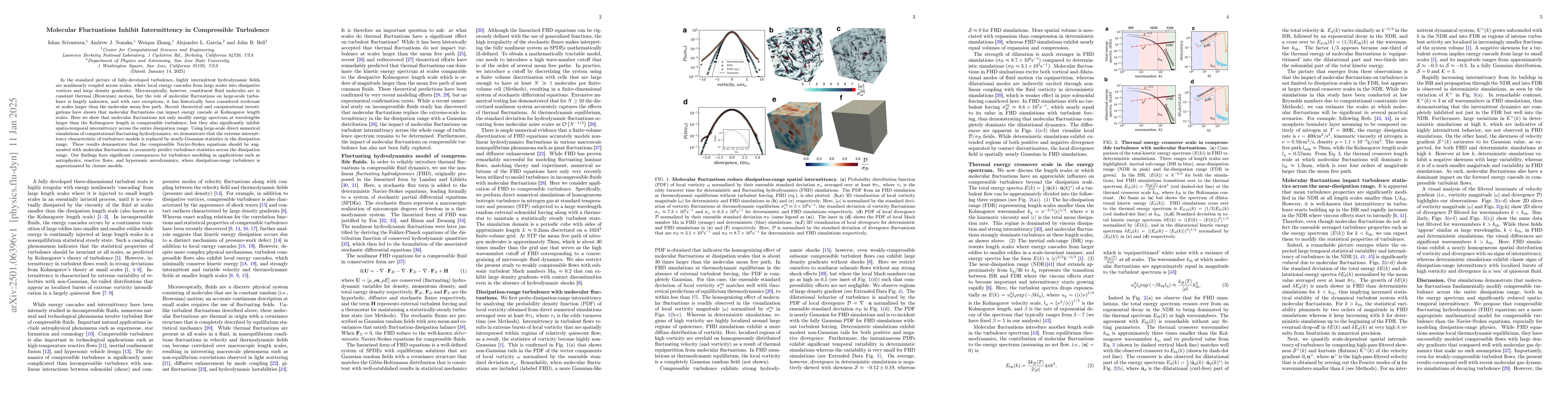
In the standard picture of fully-developed turbulence, highly intermittent hydrodynamic fields are nonlinearly coupled across scales, where local energy cascades from large scales into dissipative vortices and large density gradients. Microscopically, however, constituent fluid molecules are in constant thermal (Brownian) motion, but the role of molecular fluctuations on large-scale turbulence is largely unknown, and with rare exceptions, it has historically been considered irrelevant at scales larger than the molecular mean free path. Recent theoretical and computational investigations have shown that molecular fluctuations can impact energy cascade at Kolmogorov length scales. Here we show that molecular fluctuations not only modify energy spectrum at wavelengths larger than the Kolmogorov length in compressible turbulence, but they also significantly inhibit spatio-temporal intermittency across the entire dissipation range. Using large-scale direct numerical simulations of computational fluctuating hydrodynamics, we demonstrate that the extreme intermittency characteristic of turbulence models is replaced by nearly-Gaussian statistics in the dissipation range. These results demonstrate that the compressible Navier-Stokes equations should be augmented with molecular fluctuations to accurately predict turbulence statistics across the dissipation range. Our findings have significant consequences for turbulence modeling in applications such as astrophysics, reactive flows, and hypersonic aerodynamics, where dissipation-range turbulence is approximated by closure models.
AI Key Findings
Get AI-generated insights about this paper's methodology, results, significance, and more — available when analysis has been generated.
Discussion 0