Molecular structure breaks universality in screening behavior of electrolyte solutions
Abstract
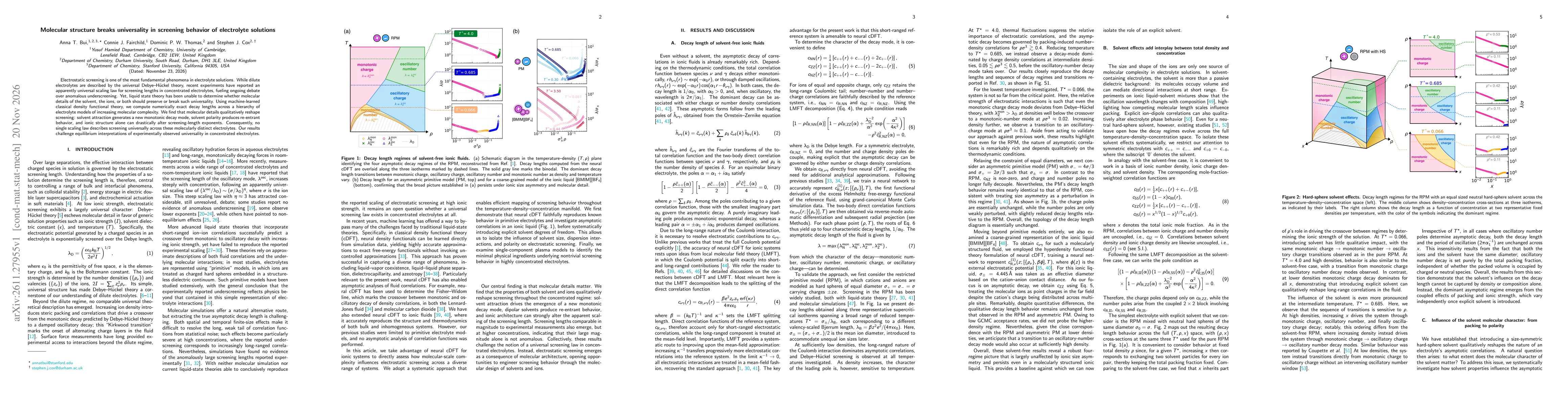
Electrostatic screening is one of the most fundamental phenomena in electrolyte solutions. While dilute electrolytes are described by the universal Debye--Hückel theory, recent experiments have reported an apparently universal scaling law for screening lengths in concentrated electrolytes, fueling ongoing debate over anomalous underscreening. Yet, liquid state theory has been unable to determine whether molecular details of the solvent, the ions, or both should preserve or break such universality. Using machine-learned classical density functional theory, we compute numerically exact decay lengths across a hierarchy of electrolyte models of increasing molecular complexity. We find that molecular details qualitatively reshape screening: solvent attraction generates a new monotonic decay mode, solvent polarity produces re-entrant behavior, and ionic structure alone can drastically alter screening-length exponents. Consequently, no single scaling law describes screening universally across these molecularly distinct electrolytes. Our results challenge equilibrium interpretations of experimentally observed universality in concentrated electrolytes.
Analysis
AI-generated · verify against the original paper
Generated Jan 1, 0001ResultsWhat the authors found
- Solvent attraction generates a new monotonic decay mode in the screening behavior.
- Polar solvents produce re‑entrant screening behavior as concentration changes.
- Variations in ionic structure drastically alter the exponents governing screening‑length scaling.
- No single universal scaling law describes screening across the molecularly distinct electrolyte models.
- Screening lengths comparable to experimental measurements emerge, but only at higher concentrations than those reported experimentally.
LimitationsWhere the findings need caution
- The analysis is confined to equilibrium properties and does not address non‑equilibrium effects.
- Neural cDFT relies on training data and approximations that may limit quantitative accuracy for real systems.
MethodologyHow the work was done
We employed machine‑learned classical density functional theory (neural cDFT) to compute numerically exact decay lengths for a hierarchy of electrolyte models with increasing molecular complexity, systematically varying solvent size, dispersion interactions, polarity, and ionic architecture.
SignificanceWhy the work matters
The study demonstrates that molecular details of both solvent and ions fundamentally reshape electrostatic screening, challenging the notion of a universal underscreening law in concentrated electrolytes and suggesting new routes for engineering screening via molecular design.
Technical contributionsWhat the work introduces
Introduction of a neural‑network‑based classical density functional approach to accurately predict asymptotic decay lengths in ionic fluids with explicit molecular detail, enabling systematic comparison across primitive and molecular electrolyte models.
NoveltyHow it differs from prior work
First demonstration that molecular-level solvent and ion characteristics break the presumed universality of screening laws in concentrated electrolytes using machine‑learned cDFT.
Future workQuestions that remain
- Extend the framework to capture dynamic and non‑equilibrium screening phenomena.
- Incorporate more realistic solvent models and validate predictions against a broader set of experimental data.
- Explore the design of solvents and ions to tailor screening for specific applications.
Discussion 0