Multi-Angle Beam Scanning Transmission Electron Microscopy for Diffraction-Contrast-Free Magnetic Imaging
Abstract
Recent development of the differential phase contrast (DPC) scanning transmission electron microscopy (STEM) technique has significantly advanced materials science supported by high-sensitivity detectors and powerful data processing. Especially the 4D-STEM technique, employing a pixelated camera as a STEM detector, enables extensive information acquisition through post-processing of large datasets. However, magnetic or electric field imaging using DPC is often disturbed by diffraction contrasts intrinsic to the crystalline material. In this paper, we demonstrate elimination of the diffraction contrasts for magnetic field imaging by using angularly distributed multiple electron beams generated by a multi-hole aperture within the 4D-STEM framework. This multi-angle beam configuration suppresses irrelevant crystalline contrast and yields direct magnetic information with high sensitivity from the specimen. Furthermore, we performed various image analysis to extract and interpret magnetic domain structures and domain walls.
Analysis
AI-generated · verify against the original paper
Generated Jan 1, 0001ResultsWhat the authors found
- Diffraction contrasts inherent to crystalline specimens are eliminated, enabling direct magnetic field imaging with high sensitivity.
- The multi‑angle beam configuration allows visualization of sub‑beam‑size magnetic domain structures and domain walls.
- The acquired 4D‑STEM datasets also retain diffraction‑related information for additional analysis.
LimitationsWhere the findings need caution
- With too few holes in the aperture, directionality artifacts appear, making the method sensitive to specific diffraction directions.
MethodologyHow the work was done
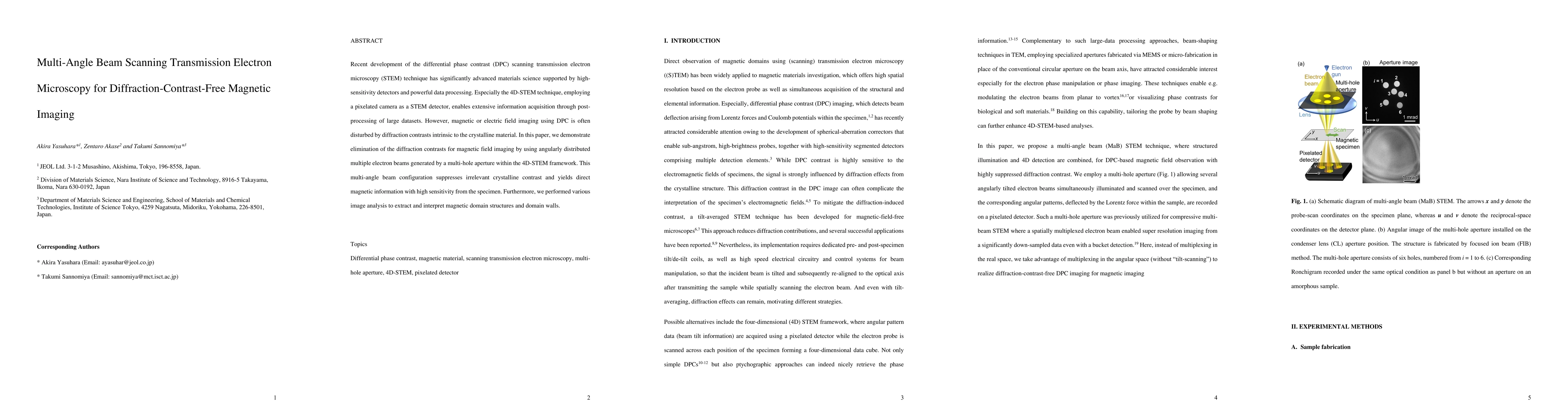
A multi-hole aperture is used to generate angularly distributed multiple electron beams within a 4D-STEM framework; differential phase contrast (DPC) images are obtained by calculating center-of-mass (CoM) shifts via cross‑correlation of diffraction patterns at each probe position.
SignificanceWhy the work matters
The approach provides diffraction‑contrast‑free magnetic imaging, overcoming a major limitation of conventional DPC‑STEM and expanding the capability of 4D‑STEM for magnetic material characterization.
Technical contributionsWhat the work introduces
Introduction of a multi‑angle beam configuration using a multi‑hole aperture within 4D‑STEM to suppress irrelevant crystalline contrast while preserving magnetic signal.
NoveltyHow it differs from prior work
First demonstration of diffraction‑contrast‑free magnetic imaging by employing angularly distributed multiple electron beams generated by a multi‑hole aperture in the 4D‑STEM DPC technique.
Discussion 0