Multisymplectic structure of nonintegrable Henon-Heiles system
This paper introduces a second invariant symplectic form for the nonintegrable Henon-Heiles system and related systems, enabling the construction of a multi-symplectic integrator that preserves both symplectic structures. This approach extends the applicability of multi-symplectic integrators beyond generic finite-dimensional Hamiltonian systems.
Abstract
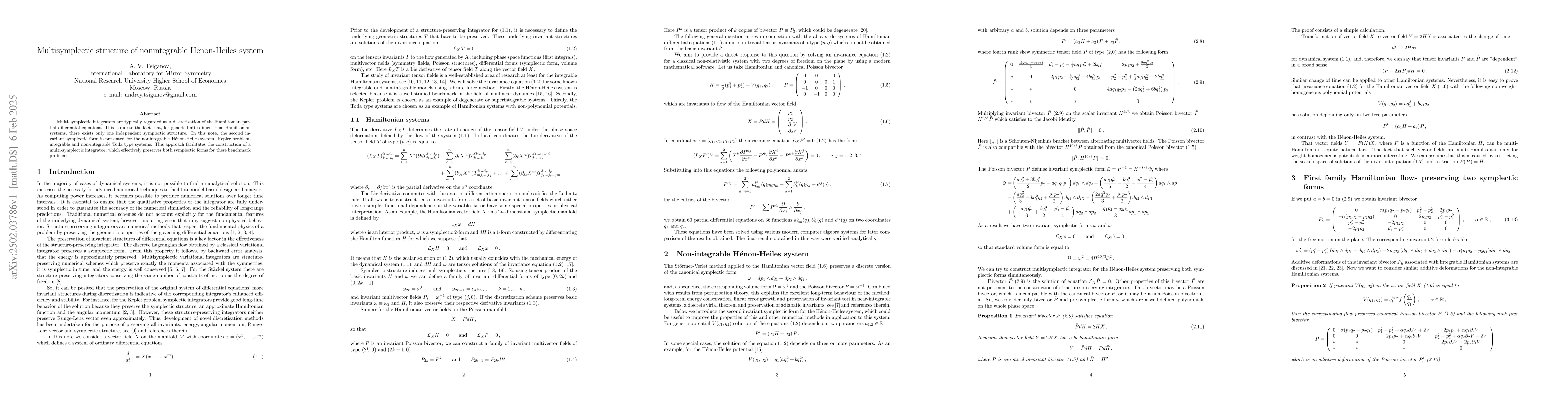
Multi-symplectic integrators are typically regarded as a discretization of the Hamiltonian partial differential equations. This is due to the fact that, for generic finite-dimensional Hamiltonian systems, there exists only one independent symplectic structure. In this note, the second invariant symplectic form is presented for the nonintegrable Henon-Heiles system, Kepler problem, integrable and non-integrable Toda type systems. This approach facilitates the construction of a multi-symplectic integrator, which effectively preserves both symplectic forms for these benchmark problems.
Analysis
AI-generated · verify against the original paper
Generated Jun 11, 2025ResultsWhat the authors found
- Second invariant symplectic form identified for nonintegrable Henon-Heiles system and other benchmark problems.
- Multi-symplectic integrator constructed to preserve both symplectic forms effectively.
LimitationsWhere the findings need caution
- The study focuses on specific systems (Henon-Heiles, Kepler, Toda), so generalizability to other systems is not addressed.
- No comparison with existing multi-symplectic integrators in terms of accuracy or efficiency is provided.
MethodologyHow the work was done
The paper presents a second invariant symplectic form for nonintegrable Henon-Heiles system, Kepler problem, and Toda type systems, facilitating the construction of a multi-symplectic integrator.
SignificanceWhy the work matters
This research is important as it extends the application of multi-symplectic integrators beyond Hamiltonian PDEs, allowing for their use in finite-dimensional systems with multiple symplectic structures, which may impact numerical simulations in physics and engineering.
Technical contributionsWhat the work introduces
Introduction of a second invariant symplectic form and its application in constructing multi-symplectic integrators for nonintegrable systems.
NoveltyHow it differs from prior work
This work distinguishes itself by identifying and utilizing a second symplectic form in finite-dimensional systems, expanding the scope of multi-symplectic integrators beyond their traditional Hamiltonian PDE applications.
Future workQuestions that remain
- Explore the applicability of this method to a broader class of nonintegrable systems.
- Conduct a comparative analysis with existing multi-symplectic integrators.
Discussion 0