N-1 Security constrained Hosting Capacity Assessment for Ultra Large-scale Data Center with Workload Flexibility
Abstract
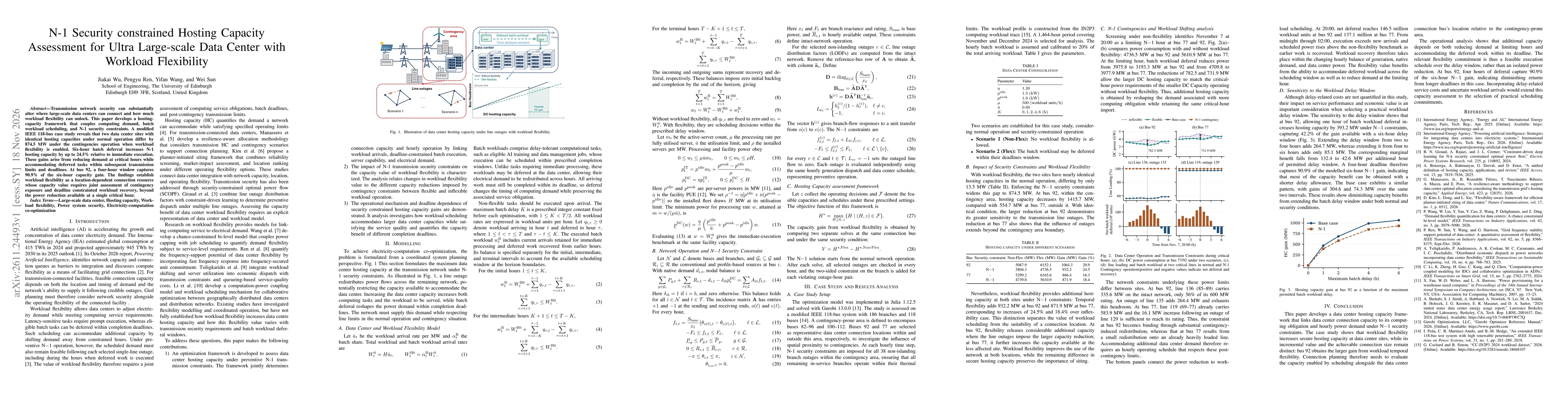
Transmission network security can substantially alter where large-scale data centers can connect and how much workload flexibility can unlock. This paper develops a hosting-capacity framework that couples computing demand, batch workload scheduling, and N-1 security constraints. A modified IEEE 118-bus case study reveals that two data center sites with identical hosting capacities under normal operation differ by 874.5 MW under the contingencies operation when workload flexibility is enabled. Six-hour batch deferral increases N-1 hosting capacity by up to 24.5\% relative to immediate execution. These gains arise from reducing demand at critical hours while accommodating deferred tasks within subsequent transmission limits and deadlines. At bus 92, a four-hour window captures 90.9\% of the six-hour capacity gain. The findings establish workload flexibility as a location-dependent connection resource whose capacity value requires joint assessment of contingency exposure and deadline constrainted workload recovery, beyond the power reduction available at a single critical hour.
AI Key Findings — Failed
The paper source is temporarily unavailable. Please try again later.
Discussion 0