The study uses ALMA and VLA observations to survey protostellar multiplicity in Taurus, finding a higher fraction of multiple systems (MF ≈ 0.53, CF ≈ 0.72) than in more clustered regions, suggesting Taurus preserves more primordial multiples. The data reveal both close and wide binaries, with a deficit at intermediate 200–300 au separations, implying two formation pathways: disk fragmentation for close systems and core fragmentation for wide ones.
Abstract
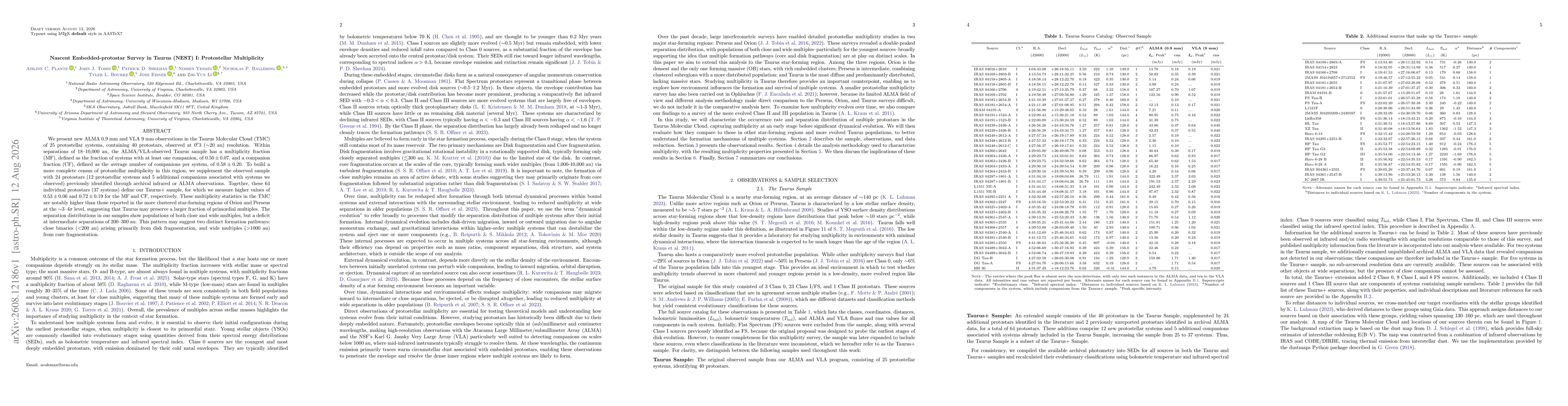
We present new ALMA 0.9 mm and VLA 9 mm observations in the Taurus Molecular Cloud (TMC) of 25 protostellar systems, containing 40 protostars, observed at 0.3" (~20 au) resolution. Within separations of 18-10,000 au, the ALMA/VLA-observed Taurus sample has a multiplicity fraction (MF), defined as the fraction of systems with at least one companion, of 0.50 +/- 0.07, and a companion fraction (CF), defined as the average number of companions per system, of 0.58 +/- 0.20. To build a more complete census of protostellar multiplicity in this region, we supplement the observed sample with 24 protostars (12 protostellar systems and 5 additional companions associated with systems we observed) previously identified through archival infrared or ALMA observations. Together, these 64 individual protostars (37 systems) define our Taurus+ sample, for which we measure higher values of 0.53 +/- 0.06 and 0.72 +/- 0.19 for the MF and CF, respectively. These multiplicity statistics in the TMC are notably higher than those reported in the more clustered star-forming regions of Orion and Perseus at the ~3-4 sigma level, suggesting that Taurus may preserve a larger fraction of primordial multiples. The separation distributions in our samples show populations of both close and wide multiples, but a deficit at intermediate separations of 200-300 au. This pattern may suggest two distinct formation pathways: close binaries (<200 au) arising primarily from disk fragmentation, and wide multiples (>1000 au) from core fragmentation.
Analysis
AI-generated · verify against the original paper
Generated Aug 14, 2026ResultsWhat the authors found
- In the primary ALMA/VLA Taurus sample, MF = 0.50 ± 0.07 and CF = 0.58 ± 0.20 for separations 18–10,000 au.
- Taurus+ sample yields MF = 0.53 ± 0.06 and CF = 0.72 ± 0.19, indicating higher multiplicity than in Orion and Perseus at ~3–4σ.
- Multiplicity distributions show both close and wide multiples with a deficit at 200–300 au, suggesting two formation pathways.
- Close multiples (<200 au) likely arise from disk fragmentation; wide multiples (>1000 au) from core fragmentation.
LimitationsWhere the findings need caution
- Sample completeness limited by selection of protostellar systems and archival data integration, potentially biasing MF/CF estimates.
- Small-number statistics in some separation bins may affect the precision of the inferred deficit at 200–300 au.
- Assumption of a single separation range for all systems may overlook complex hierarchical configurations.
MethodologyHow the work was done
High-resolution (0.3 arcsec) ALMA 0.9 mm and VLA 9 mm observations of 25 protostellar systems (40 protostars) in Taurus, supplemented with archival infrared/ALMA data to assemble a Taurus+ sample of 64 protostars (37 systems). Multiplicity statistics (MF and CF) computed for separations 18–10,000 au, with comparison to clustered regions Orion and Perseus to infer primordial multiplicity and potential dual formation pathways. Separation distributions analyzed to identify deficits at intermediate separations, informing formation channels (disk fragmentation for close binaries; core fragmentation for wide multiples).
SignificanceWhy the work matters
Taurus may preserve a larger fraction of primordial multiples compared to more clustered regions, providing important constraints on early multiplicity and formation pathways in low-density environments.
Technical contributionsWhat the work introduces
Provides the first statistically robust, high-resolution assessment of protostellar multiplicity in Taurus across a broad separation range, incorporating archival data to assemble a near-complete Taurus+ census and linking separation patterns to fragmentation formation channels.
NoveltyHow it differs from prior work
Demonstrates a notably higher protostellar multiplicity in Taurus than in more clustered regions and reveals a potential bimodal formation scenario (disk vs. core fragmentation) reflected in the observed separation distribution and MF/CF values.
Future workQuestions that remain
- Expand Taurus sample with deeper, higher-resolution surveys to improve separation coverage below 100 au.
- Obtain uniform multi-epoch observations to assess dynamical stability and evolution of identified multiples.
- Compare with additional nearby star-forming regions using consistent methodologies to refine environmental effects on multiplicity.
Discussion 0