Naturalness of electroweak physics within minimal supergravity
This paper investigates the naturalness of electroweak physics in the minimal supergravity model, applying the latest experimental constraints and evaluating the fine tuning at 2-loop order. The study finds minimal fine tuning of 1 part in 15 when dark matter constraints are considered, suggesting minimal supergravity remains viable with respect to naturalness.
Abstract
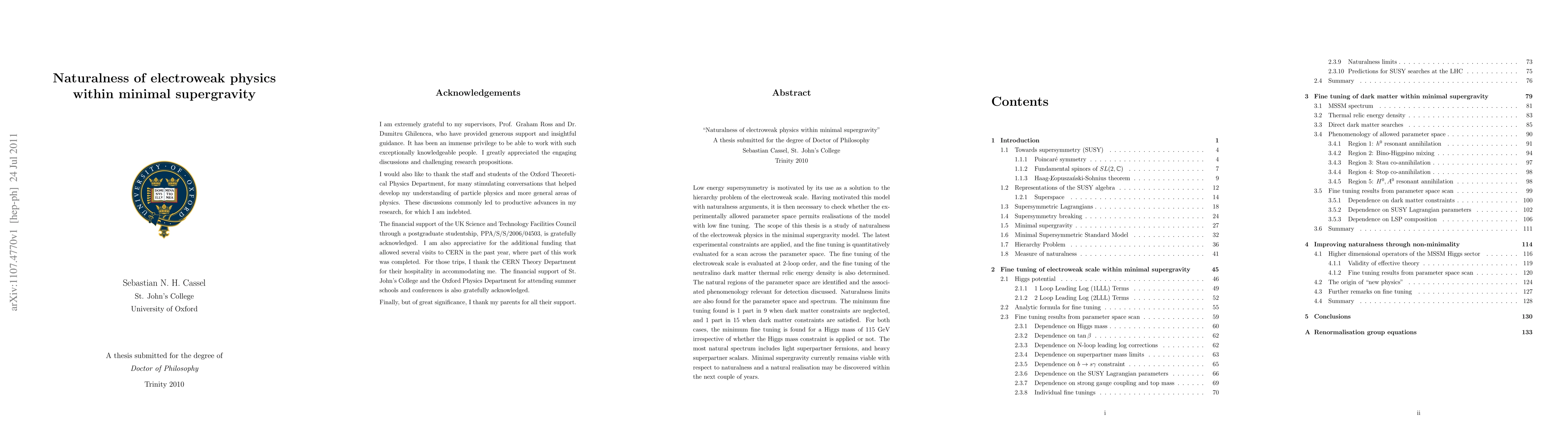
Low energy supersymmetry is motivated by its use as a solution to the hierarchy problem of the electroweak scale. Having motivated this model with naturalness arguments, it is then necessary to check whether the experimentally allowed parameter space permits realisations of the model with low fine tuning. The scope of this thesis is a study of naturalness of the electroweak physics in the minimal supergravity model. The latest experimental constraints are applied, and the fine tuning is quantitatively evaluated for a scan across the parameter space. The fine tuning of the electroweak scale is evaluated at 2-loop order, and the fine tuning of the neutralino dark matter thermal relic energy density is also determined. The natural regions of the parameter space are identified and the associated phenomenology relevant for detection discussed. Naturalness limits are also found for the parameter space and spectrum. The minimum fine tuning found is 1 part in 9 when dark matter constraints are neglected, and 1 part in 15 when dark matter constraints are satisfied. For both cases, the minimum fine tuning is found for a Higgs mass of 115 GeV irrespective of whether the Higgs mass constraint is applied or not. The most natural spectrum includes light superpartner fermions, and heavy superpartner scalars. Minimal supergravity currently remains viable with respect to naturalness and a natural realisation may be discovered within the next couple of years.
AI Key Findings
Get AI-generated insights about this paper's methodology, results, significance, and more — available when analysis has been generated.
Discussion 0