NavDecision: Parallel Multi-Step Action Prediction with Persistent Self-Referential Learning for Vision-and-Language Navigation
Abstract
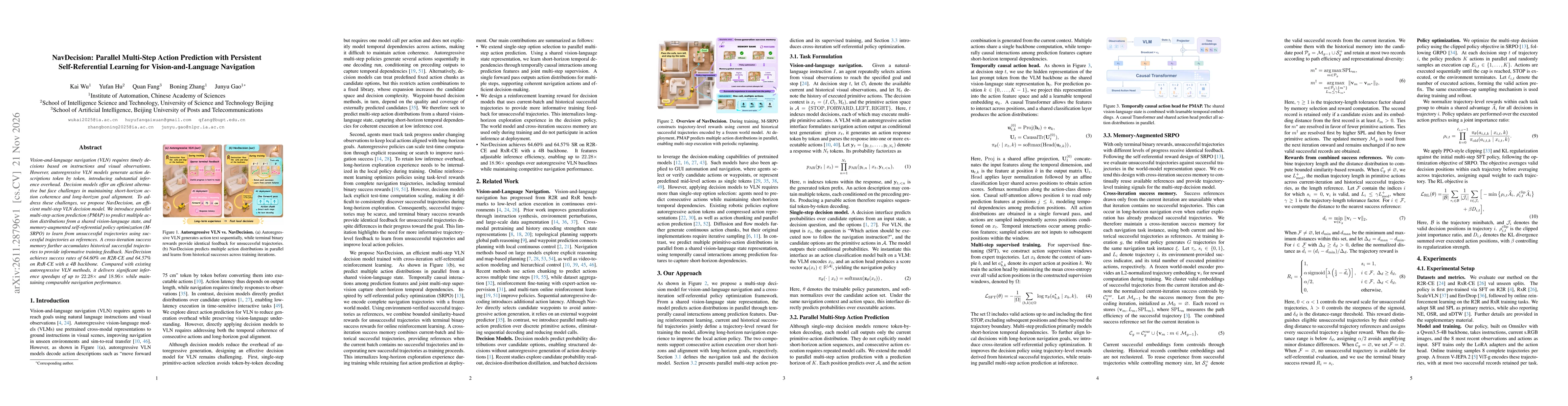
Vision-and-language navigation (VLN) requires timely decisions based on instructions and visual observations. However, autoregressive VLN models generate action descriptions token by token, introducing substantial inference overhead. Decision models offer an efficient alternative but face challenges in maintaining short-horizon action coherence and long-horizon goal alignment. To address these challenges, we propose NavDecision, an efficient multi-step VLN decision model. We introduce parallel multi-step action prediction (PMAP) to predict multiple action distributions from a shared vision-language state, and memory-augmented self-referential policy optimization (M-SRPO) to learn from unsuccessful trajectories using successful trajectories as references. A cross-iteration success memory further accumulates historical successful trajectories to provide informative training feedback. NavDecision achieves success rates of 64.60% on R2R-CE and 64.57% on RxR-CE with a 4B backbone. Compared with existing autoregressive VLN methods, it delivers significant inference speedups of up to $22.28\times$ and $18.96\times$ while maintaining comparable navigation performance.
AI Key Findings
Get AI-generated insights about this paper's methodology, results, significance, and more — available when analysis has been generated.
Discussion 0