Near-Field Communications: What Will Be Different?
This paper explores the distinctions between near-field communications (NFC) and far-field communications (FFC) from four perspectives: novel channel modeling, performance analysis, beamforming techniques, and application-driven designs. It proposes new NFC channel models and beamforming structures, and discusses potential advancements in distance-aware sensing and security for next-generation NFC technologies.
Abstract
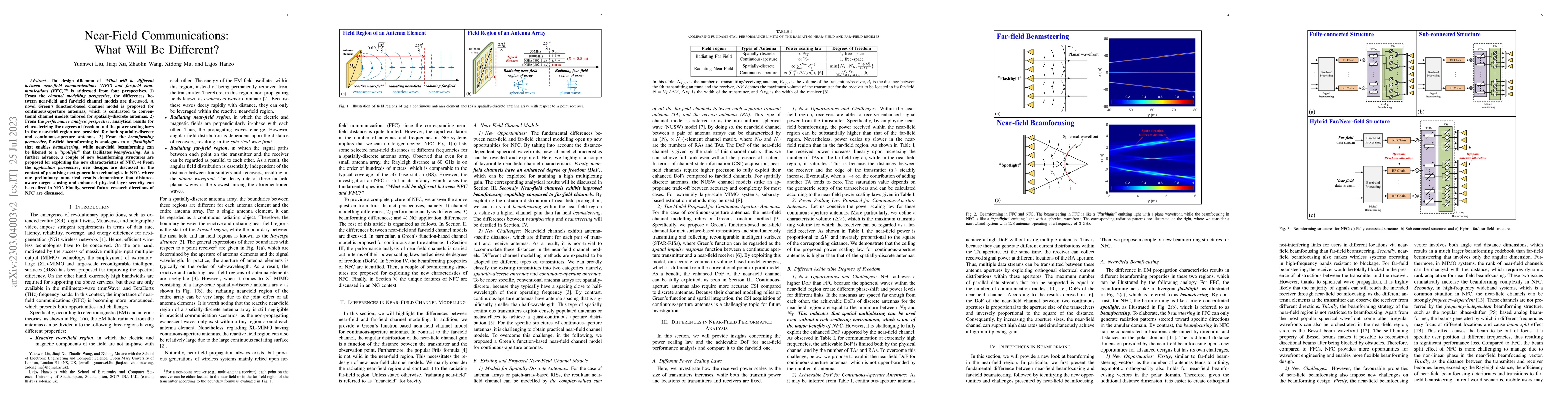
The design dilemma of "What will be different between near-field communications (NFC) and far-field communications (FFC)?" is addressed from four perspectives. 1) From the channel modelling perspective, the differences between near-field and far-field channel models are discussed. A novel Green's function-based channel model is proposed for continuous-aperture antennas, which is contrasted to conventional channel models tailored for spatially-discrete antennas. 2) From the performance analysis perspective, analytical results for characterizing the degrees of freedom and the power scaling laws in the near-field region are provided for both spatially-discrete and continuous-aperture antennas. 3) From the beamforming perspective, far-field beamforming is analogous to a "flashlight" that enables beamsteering, while near-field beamforming can be likened to a "spotlight" that facilitates beamfocusing. As a further advance, a couple of new beamforming structures are proposed for exploiting the new characteristics of NFC. 4) From the application perspective, new designs are discussed in the context of promising next-generation technologies in NFC, where our preliminary numerical results demonstrate that distance-aware target sensing and enhanced physical layer security can be realized in NFC. Finally, several future research directions of NFC are discussed.
AI Key Findings
Get AI-generated insights about this paper's methodology, results, significance, and more — available when analysis has been generated.
Discussion 0