Networks are Slacking Off: Understanding Generalization Problem in Image Deraining
This paper investigates the generalization problem in deep deraining networks, finding that overly complex training data worsens overfitting. Instead, simplifying training backgrounds enhances generalization by preventing networks from focusing on the least complex elements, thus improving real-world performance.
Abstract
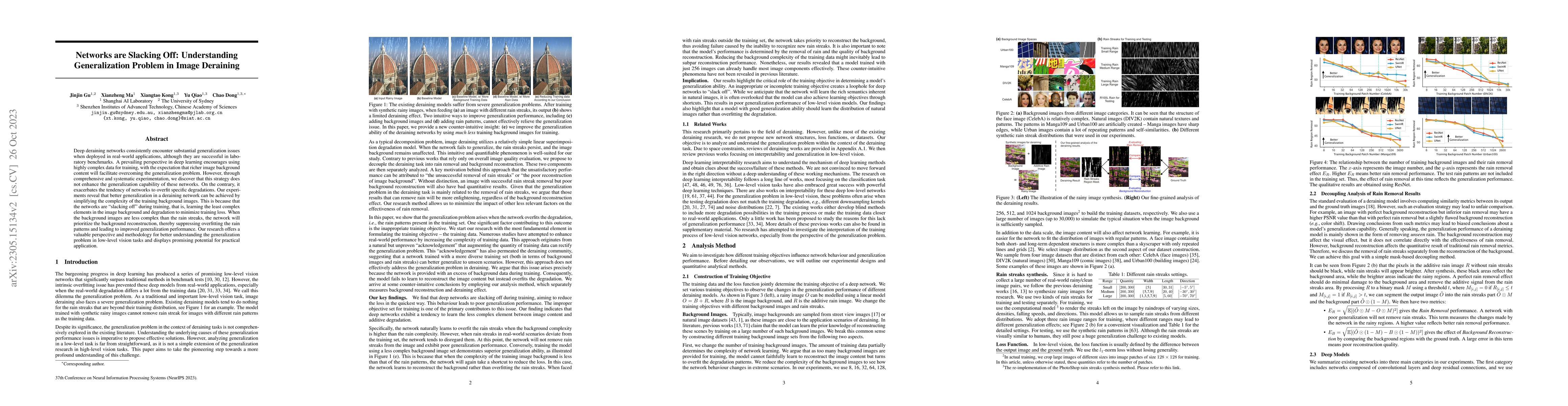
Deep deraining networks consistently encounter substantial generalization issues when deployed in real-world applications, although they are successful in laboratory benchmarks. A prevailing perspective in deep learning encourages using highly complex data for training, with the expectation that richer image background content will facilitate overcoming the generalization problem. However, through comprehensive and systematic experimentation, we discover that this strategy does not enhance the generalization capability of these networks. On the contrary, it exacerbates the tendency of networks to overfit specific degradations. Our experiments reveal that better generalization in a deraining network can be achieved by simplifying the complexity of the training background images. This is because that the networks are ``slacking off'' during training, that is, learning the least complex elements in the image background and degradation to minimize training loss. When the background images are less complex than the rain streaks, the network will prioritize the background reconstruction, thereby suppressing overfitting the rain patterns and leading to improved generalization performance. Our research offers a valuable perspective and methodology for better understanding the generalization problem in low-level vision tasks and displays promising potential for practical application.
AI Key Findings
Get AI-generated insights about this paper's methodology, results, significance, and more — available when analysis has been generated.
Discussion 0