NightIQA: A Comprehensive Dataset and Benchmark for MLLM-Based Nighttime Image Quality Assessment
Abstract
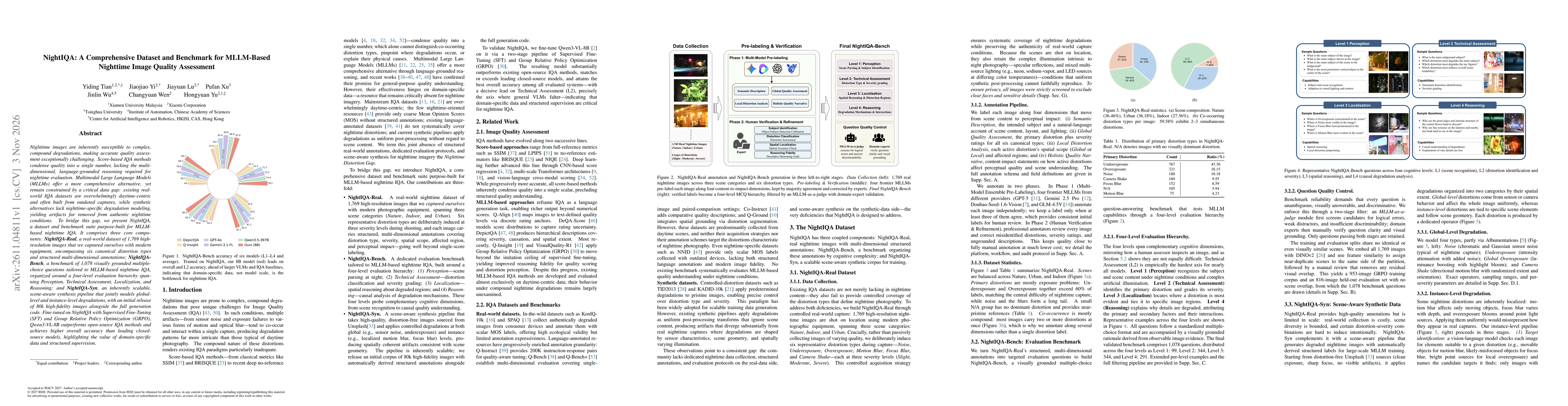
Nighttime images are inherently susceptible to complex, compound degradations, making accurate quality assessment exceptionally challenging. Score-based IQA methods condense quality into a single number, lacking the multi-dimensional, language-grounded reasoning required for nighttime evaluation. Multimodal Large Language Models (MLLMs) offer a more comprehensive alternative, yet remain constrained by a critical data gap: existing real-world IQA datasets are overwhelmingly daytime-centric and often built from outdated captures, while synthetic alternatives lack nighttime-specific degradation modeling, yielding artifacts far removed from authentic nighttime conditions. To bridge this gap, we present NightIQA, a dataset and benchmark suite purpose-built for MLLM-based nighttime IQA. It comprises three core components: NightIQA-Real, a real-world dataset of 1,769 high-resolution images that we captured ourselves with modern equipment, encompassing six canonical distortion types and structured multi-dimensional annotations; NightIQA-Bench, a benchmark of 1,078 visually grounded multiple-choice questions tailored to MLLM-based nighttime IQA, organized around a four-level evaluation hierarchy spanning Perception, Technical Assessment, Localization, and Reasoning; and NightIQA-Syn, an inherently scalable, scene-aware synthesis pipeline that jointly models global-level and instance-level degradations, with an initial release of 80k high-fidelity images alongside the full generation code. Fine-tuned on NightIQA with Supervised Fine-Tuning (SFT) and Group Relative Policy Optimization (GRPO), Qwen3-VL-8B outperforms open-source IQA methods and achieves higher overall accuracy than leading closed-source models, highlighting the value of domain-specific data and structured supervision.
Analysis
AI-generated · verify against the original paper
Generated Jan 1, 0001ResultsWhat the authors found
- Qwen3‑VL‑8B fine‑tuned on NightIQA outperforms existing open‑source IQA methods and achieves higher overall accuracy than leading closed‑source models.
- The model shows a decisive lead on the Technical Assessment (L2) level, indicating that domain‑specific data and structured supervision are critical for nighttime IQA.
MethodologyHow the work was done
The authors construct NightIQA comprising three components: NightIQA-Real (1,769 high‑resolution nighttime images with six distortion types and multi‑dimensional annotations), NightIQA-Bench (1,078 multiple‑choice questions organized into a four‑level hierarchy: Perception, Technical Assessment, Localization, and Reasoning), and NightIQA‑Syn (a scene‑aware synthesis pipeline that applies global and instance‑level degradations to generate 80k synthetic images). They fine‑tune the Qwen3‑VL‑8B model on this data using a two‑stage process: Supervised Fine‑Tuning (SFT) followed by Group Relative Policy Optimization (GRPO).
SignificanceWhy the work matters
NightIQA fills a critical gap by providing the first large‑scale, structured, nighttime‑focused dataset and benchmark for MLLM‑based image quality assessment, enabling more nuanced, language‑grounded reasoning beyond single‑score metrics.
Technical contributionsWhat the work introduces
Introduces a comprehensive nighttime IQA dataset (real, benchmark, synthetic) and a scalable scene‑aware synthesis pipeline, and demonstrates the effectiveness of SFT + GRPO fine‑tuning for MLLM‑based quality assessment.
NoveltyHow it differs from prior work
First dataset and benchmark specifically designed for multimodal large language models to assess nighttime image quality with multi‑dimensional annotations and a hierarchical evaluation framework.
Discussion 0