Nodal nematic superconductivity in moiré graphene
Abstract
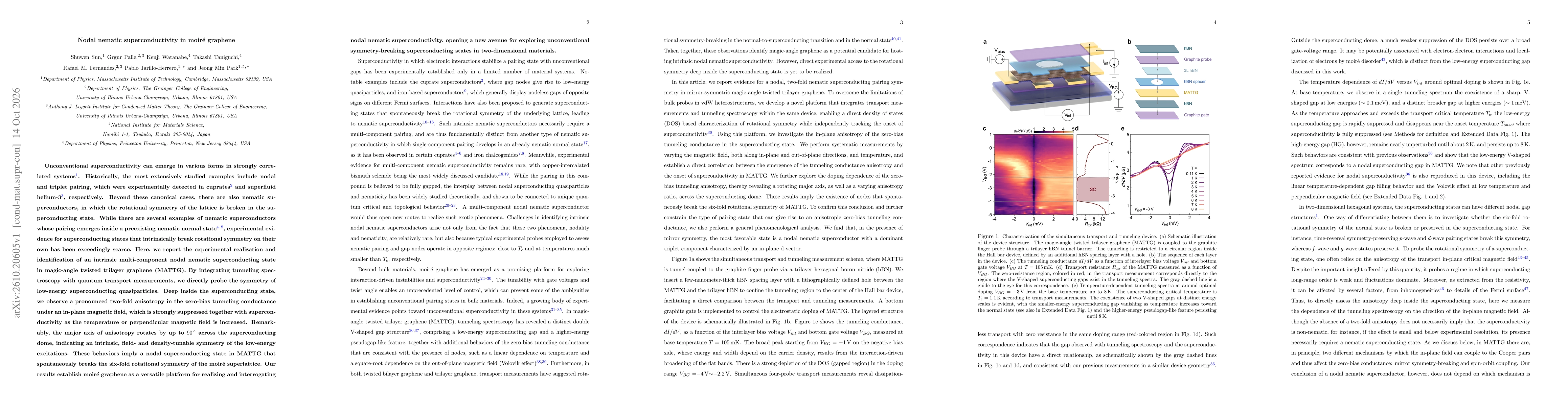
Unconventional superconductivity can emerge in various forms in strongly correlated systems. Historically, the most extensively studied examples include nodal and triplet pairing, which were experimentally detected in cuprates and superfluid helium-3, respectively. Beyond these canonical cases, there are also nematic superconductors, in which the rotational symmetry of the lattice is broken in the superconducting state. While there are several examples of nematic superconductors whose pairing emerges inside a preexisting nematic normal state, experimental evidence for superconducting states that intrinsically break rotational symmetry on their own has been exceedingly scarce. Here, we report the experimental realization and identification of an intrinsic multi-component nodal nematic superconducting state in magic-angle twisted trilayer graphene (MATTG). By integrating tunneling spectroscopy with quantum transport measurements, we directly probe the symmetry of low-energy superconducting quasiparticles. Deep inside the superconducting state, we observe a pronounced two-fold anisotropy in the zero-bias tunneling conductance under an in-plane magnetic field, which is strongly suppressed together with superconductivity as the temperature or perpendicular magnetic field is increased. Remarkably, the major axis of anisotropy rotates by up to $90^{\circ}$ across the superconducting dome, indicating an intrinsic, field- and density-tunable symmetry of the low-energy excitations. These behaviors imply a nodal superconducting state in MATTG that spontaneously breaks the six-fold rotational symmetry of the moiré superlattice. Our results establish moiré graphene as a versatile platform for realizing and interrogating nodal nematic superconductivity, opening a new avenue for exploring unconventional symmetry-breaking superconducting states in two-dimensional materials.
AI Key Findings
Get AI-generated insights about this paper's methodology, results, significance, and more — available when analysis has been generated.
Discussion 0