Noise threshold for learning with quantum memory
Abstract
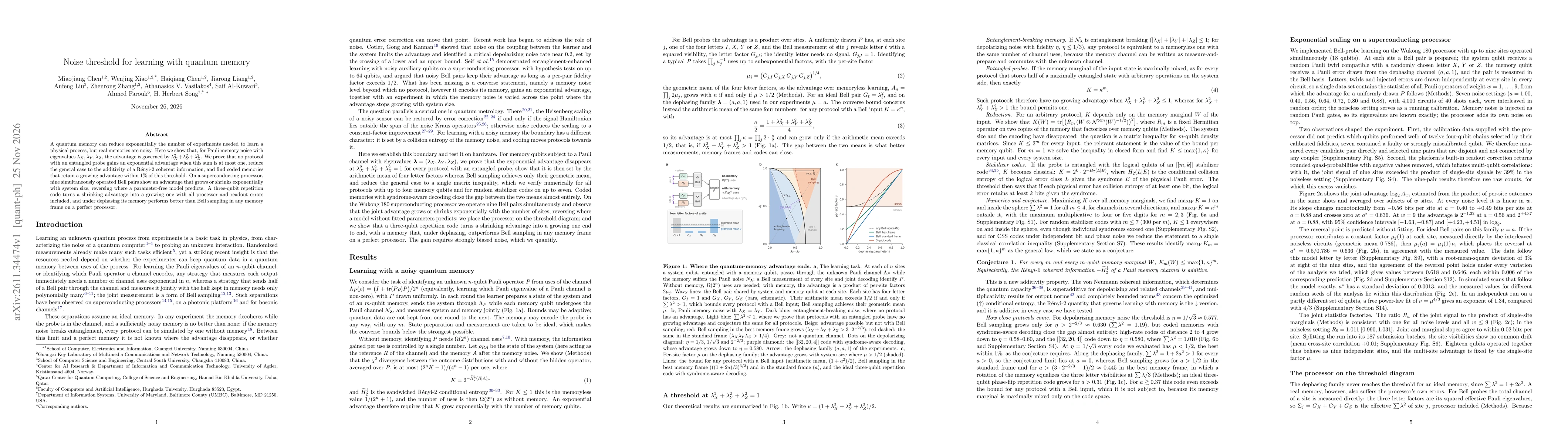
A quantum memory can reduce exponentially the number of experiments needed to learn a physical process, but real memories are noisy. Here we show that, for Pauli memory noise with eigenvalues $λ_X,λ_Y,λ_Z$, the advantage is governed by $λ_X^2+λ_Y^2+λ_Z^2$. We prove that no protocol with an entangled probe gains an exponential advantage when this sum is at most one, reduce the general case to the additivity of a Rényi-2 coherent information, and find coded memories that retain a growing advantage within 1% of this threshold. On a superconducting processor, nine simultaneously operated Bell pairs show an advantage that grows or shrinks exponentially with system size, reversing where a parameter-free model predicts. A three-qubit repetition code turns a shrinking advantage into a growing one with all processor and readout errors included, and under dephasing its memory performs better than Bell sampling in any memory frame on a perfect processor.
AI Key Findings
Get AI-generated insights about this paper's methodology, results, significance, and more — available when analysis has been generated.
Discussion 0