The authors build an active mechanical lattice where pairs of oscillators encode a local pseudo-spin and inter-site, spin-dependent couplings are controlled in real time, enabling a tunable non-Abelian gauge field. They measure Wilson-loop observables, demonstrate non-Abelian behavior, and show how non-Hermiticity induces direction-dependent effects in 2D and shifts non-Hermitian skin localization in 1D, highlighting a programmable platform to study complex gauge-field physics.
Abstract
Non-Abelian gauge fields play a key role in describing the behavior of particles whose motion is coupled to internal degrees of freedom, such as their spin. Here, we experimentally realize a tuneable non-Abelian gauge field in an active mechanical lattice by using pairs of oscillators to encode a local pseudo-spin for each site, with inter-site spin-dependent couplings engineered via real-time measurement and feedback. We experimentally extract Wilson-loop observables in our set-up and hence demonstrate that we can create a genuinely non-Abelian gauge field. We then exploit the controllability of our mechanical lattice to engineer non-reciprocal hoppings to explore non-Hermitian non-Abelian gauge potentials. For a two-dimensional (2D) lattice, we demonstrate that the non-Hermiticity can manifest in direction-dependent Wilson loops for a single plaquette, while for a one-dimensional (1D) system, we show that a non-Abelian gauge potential can switch the localization of non-Hermitian skin modes between opposite ends of a chain. Our work establishes active mechanical lattices as a flexible and programmable platform for probing non-Abelian gauge fields and exploring their interplay with non-Hermitian dynamics.
Analysis
AI-generated · verify against the original paper
Generated Jul 22, 2026ResultsWhat the authors found
- A genuinely non-Abelian gauge field is demonstrated by measuring Wilson-loop observables that do not commute for different loop orders, confirming path-dependent internal state transformations.
- The 2D non-Hermitian lattice shows direction-dependent Wilson loops for a single plaquette, illustrating non-Hermiticity intertwined with non-Abelian gauge structure.
- In the 1D chain, a non-Abelian gauge potential can switch the localization of non-Hermitian skin modes between opposite ends of the chain, revealing controllable directional transport of energy.
- Experimentally measured spectra and loop magnitudes agree with numerical models, validating the implemented SU(2) gauge-field dynamics via measurement-based feedback.
LimitationsWhere the findings need caution
- The system is finite and small, limiting exploration of bulk-loop statistics and thermodynamic behaviors typical of larger gauge networks.
- Reliance on measurement-based feedback introduces practical constraints, such as finite transfer fidelity and potential residual decoherence-like effects in the classical regime.
- Nonlinear energy-stabilizing feedback, while necessary for stability, may subtly affect high-amplitude dynamics and could obscure some intrinsic nonlinear gauge phenomena.
- The study focuses on SU(2)-like pseudo-spin encoding; extension to higher-rank gauge groups remains untested in this setup.
MethodologyHow the work was done
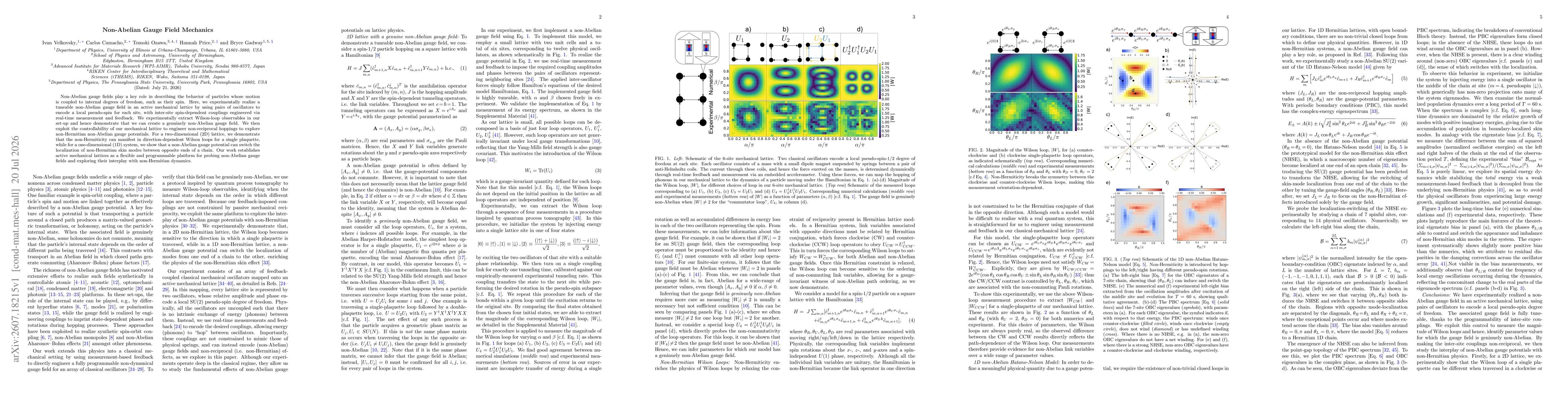
The study uses an active mechanical lattice of coupled classical oscillators, where each lattice site is represented by two oscillators encoding a local pseudo-spin. Real-time measurement and feedback implement tunable non-Abelian gauge potentials by engineering spin-dependent inter-site couplings, with the Hamiltonian mapped to a lattice model featuring link variables X = e^{i Ax} and Y = e^{i Ay} parameterized by (α, β) and Pauli matrices. Wilson-loop observables are extracted via a four-step tomography-inspired procedure: initialize a site in one of four spin states, evolve through a single coupling link for one tunneling time, rotate to the next link, and repeat to reconstruct the loop operator magnitudes |Wi|, enabling detection of non-Abelian holonomies. The experiments are conducted on a small 2D lattice for the gauge-field realization and extended to a 1D chain to study non-Hermitian effects, including non-reciprocal hoppings and non-Abelian skin-mode localization, validated against numerical simulations. A nonlinear energy-stabilizing feedback is used in the 1D experiments to maintain linear, small-amplitude dynamics while enabling directional energy flow analysis.
SignificanceWhy the work matters
This work establishes active mechanical lattices as a programmable platform for exploring synthetic non-Abelian gauge fields and their interplay with non-Hermitian physics, enabling tunable holonomies, anisotropic loop dynamics, and controllable skin-mode localization in a classical setting.
Technical contributionsWhat the work introduces
Demonstration of a tunable, real-time feedback–based implementation of non-Abelian gauge fields in an active mechanical lattice, including a protocol to measure Wilson loops via quantum-process-tomography-inspired state injections and recover SU(2) holonomies; demonstration of non-Hermitian non-Abelian effects such as direction-dependent Wilson loops and skin-mode localization control in 1D chains.
NoveltyHow it differs from prior work
First experimental realization of a genuinely non-Abelian gauge field in a programmable classical platform using measurement-based feedback, together with exploration of non-Hermitian effects and direct observation of non-commuting loop holonomies in a controllable mechanical system.
Future workQuestions that remain
- Scale up to larger lattices to study many-body-like Wilson-loop statistics and emergent gauge-field phenomena across extended plaquettes.
- Explore higher-dimensional geometries and different lattice topologies to map richer non-Abelian holonomy structures.
- Investigate robust implementations of non-Hermitian non-Abelian gauge potentials under disorder and noise, aiming at practical quantum-classical transduction schemes.
- Generalize to SU(N) gauge fields beyond SU(2) by encoding larger pseudo-spin spaces or multi-mode encodings per site.
Discussion 0