Non-negative Interfacial Tension in Phase-Separated Active Brownian Particles
This paper develops a microscopic theory to explain the nonequilibrium interfacial tension between gas and liquid phases of active Brownian particles, finding that it is non-negative, thus supporting the stability of interfaces in active systems and contradicting previous claims.
Abstract
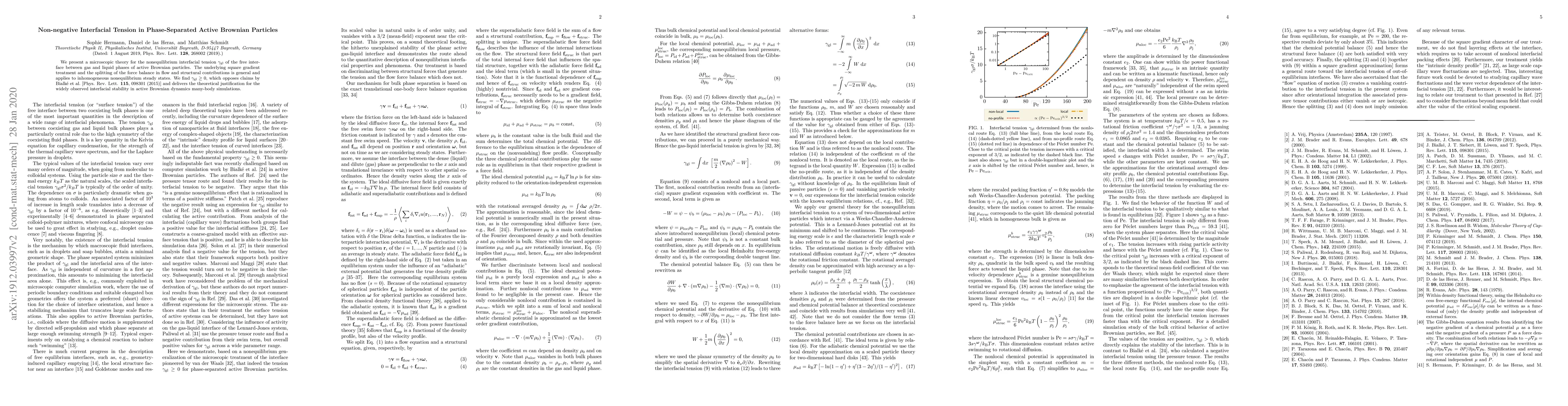
We present a microscopic theory for the nonequilibrium interfacial tension $\gamma_{\rm gl}$ of the free interface between gas and liquid phases of active Brownian particles. The underlying square gradient treatment and the splitting of the force balance in flow and structural contributions is general and applies to inhomogeneous nonequilibrium steady states. We find $\gamma_{\rm gl}\geq 0$, which opposes claims by Bialk\'e et al. [Phys. Rev. Lett. $\bf{115}$, 098301 (2015)] and delivers the theoretical justification for the widely observed interfacial stability in active Brownian dynamics many-body simulations.
AI Key Findings
Get AI-generated insights about this paper's methodology, results, significance, and more — available when analysis has been generated.
Discussion 0