Nonemissive Intermediates: Photon-Yield Limits and Timing Advantages for Optogenetic Light
Abstract
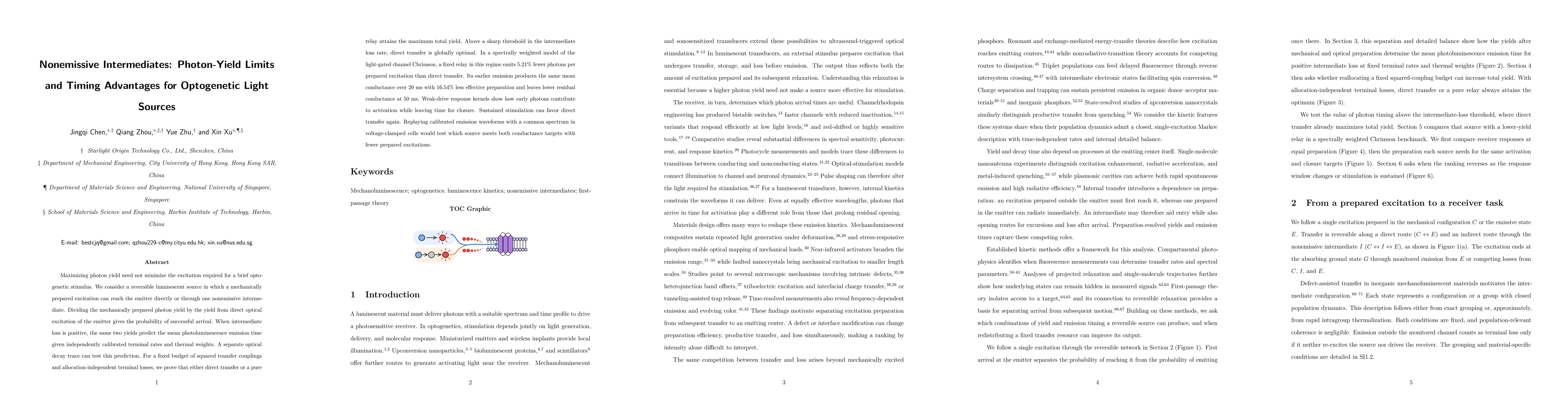
Maximizing photon yield need not minimize the excitation required for a brief optogenetic stimulus. We consider a reversible luminescent source in which a mechanically prepared excitation can reach the emitter directly or through one nonemissive intermediate. Dividing the mechanically prepared photon yield by the yield from direct optical excitation of the emitter gives the probability of successful arrival. When intermediate loss is positive, the same two yields predict the mean photoluminescence emission time given independently calibrated terminal rates and thermal weights. A separate optical decay trace can test this prediction. For a fixed budget of squared transfer couplings and allocation-independent terminal losses, we prove that either direct transfer or a pure relay attains the maximum total yield. Above a sharp threshold in the intermediate loss rate, direct transfer is globally optimal. In a spectrally weighted model of the light-gated channel Chrimson, a fixed relay in this regime emits 5.21% fewer photons per prepared excitation than direct transfer. Its earlier emission produces the same mean conductance over 20 ms with 16.54% less effective preparation and leaves lower residual conductance at 50 ms. Weak-drive response kernels show how early photons contribute to activation while leaving time for closure. Sustained stimulation can favor direct transfer again. Replaying calibrated emission waveforms with a common spectrum in voltage-clamped cells would test which source meets both conductance targets with fewer prepared excitations.
AI Key Findings
Get AI-generated insights about this paper's methodology, results, significance, and more — available when analysis has been generated.
Discussion 0