Nonresonant two-level transitions: Lessons from quantum thermodynamics
Researchers analyzed a two-level system with an electromagnetic mode to understand energy exchange in quantum thermodynamics. They found effective energies for levels and photons that help achieve a thermodynamically consistent description of energy transfer.
Abstract
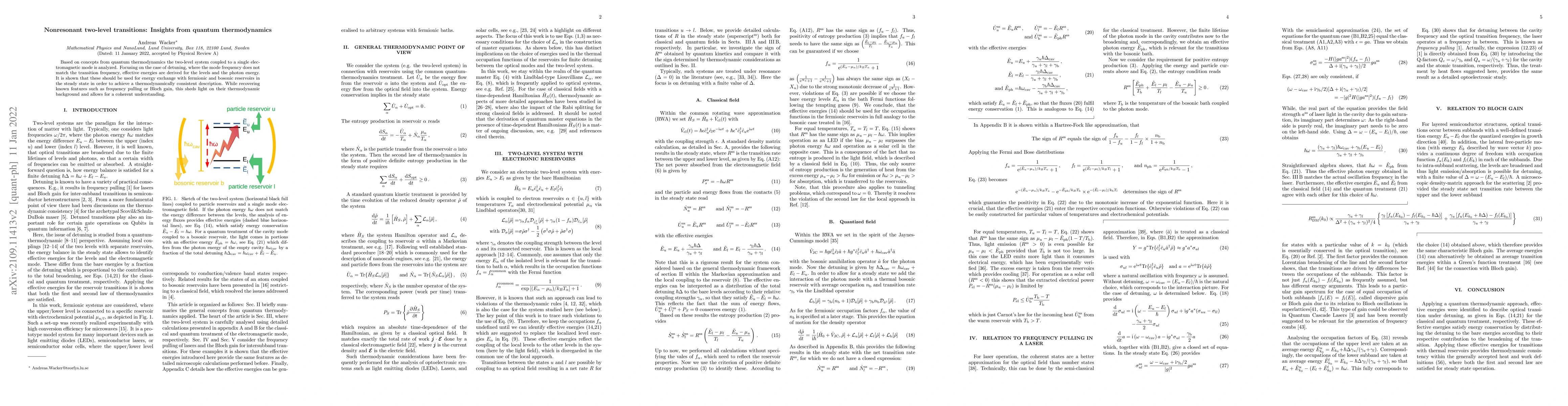
Based on concepts from quantum thermodynamics the two-level system coupled to a single electromagnetic mode is analyzed. Focusing on the case of detuning, where the mode frequency does not match the transition frequency, effective energies are derived for the levels and the photon energy. It is shown that these should be used for energy exchange with fermionic and bosonic reservoirs in the steady state in order to achieve a thermodynamically consistent description. While recovering known features such as frequency pulling or Bloch gain, this sheds light on their thermodynamic background and allows for a coherent understanding.
AI Key Findings
Get AI-generated insights about this paper's methodology, results, significance, and more — available when analysis has been generated.
Discussion 0