Not Just Any Example: Security Requirements and Fix Patterns for Guiding LLM Vulnerability Repair
Abstract
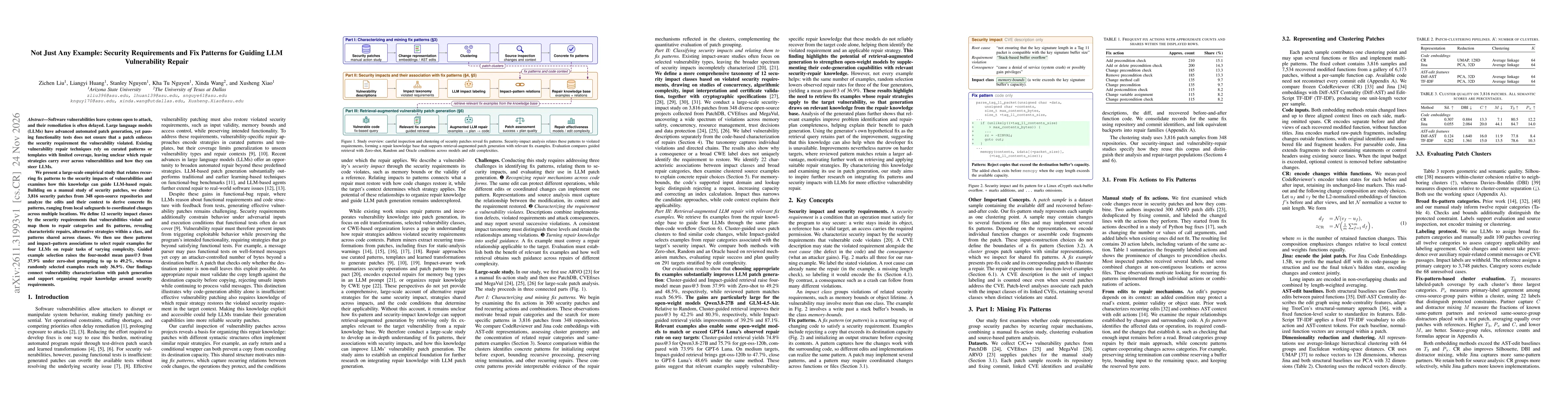
Software vulnerabilities leave systems open to attack, and their remediation is often delayed. Large language models (LLMs) have advanced automated patch generation, yet passing functionality tests does not ensure that a patch enforces the security requirement the vulnerability violated. Existing vulnerability repair techniques rely on curated patterns or templates with limited coverage, leaving unclear which repair strategies carry over across vulnerabilities and how they can steer LLMs. We present a large-scale empirical study that relates recurring fix patterns to the security impacts of vulnerabilities and examines how this knowledge can guide LLM-based repair. Building on a manual study of security patches, we cluster 3,816 security patches from 348 open-source repositories and analyze the edits and their context to derive concrete fix patterns, ranging from local safeguards to coordinated changes across multiple locations. We define 12 security impact classes by the security requirements that vulnerabilities violate and map them to repair categories and fix patterns, revealing characteristic repairs, alternative strategies within a class, and patterns shared across classes. We then use these patterns and impact-pattern associations to select repair examples for four LLMs on repair tasks of varying complexity. Guided example selection raises the four-model mean pass@3 from 37.9% under zero-shot prompting to up to 49.2%, whereas randomly selected examples reach only 36.9%. Our findings connect vulnerability characterization with patch generation and support organizing repair knowledge around security requirements.
AI Key Findings
Get AI-generated insights about this paper's methodology, results, significance, and more — available when analysis has been generated.
Discussion 0