Observation of quantized vortex in an atomic Bose-Einstein condensate at Dirac point
Researchers observed quantized vortices in an atomic Bose-Einstein condensate positioned at a Dirac point in a graphene-like optical lattice, revealing the phase diagram of lattice bosons there. This observation provides a novel method for generating vortices in quantum gases, applicable to various optical lattices with topological singularities.
Abstract
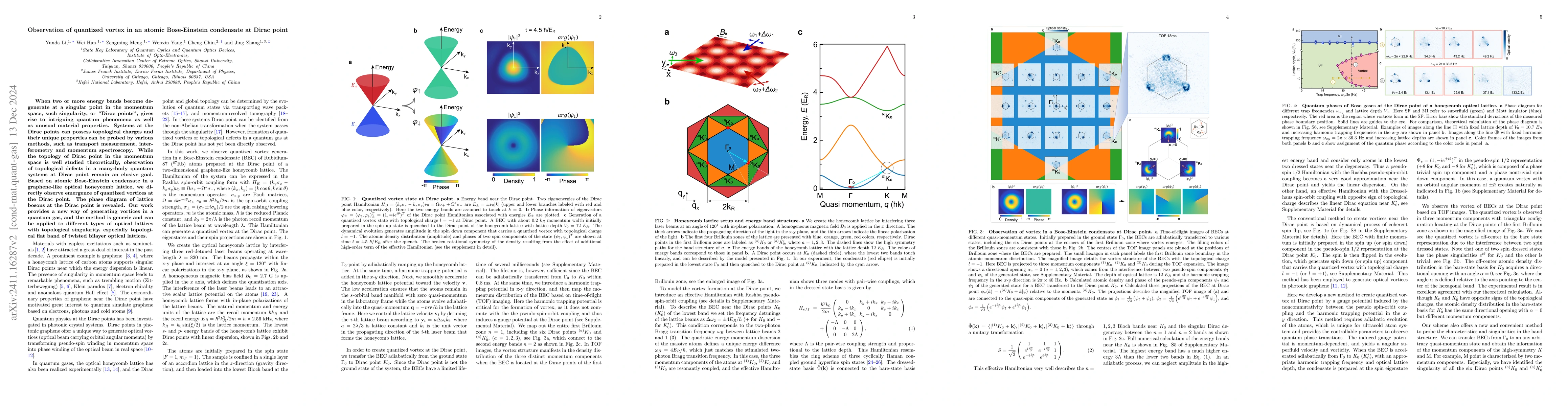
When two or more energy bands become degenerate at a singular point in the momentum space, such singularity, or ``Dirac points", gives rise to intriguing quantum phenomena as well as unusual material properties. Systems at the Dirac points can possess topological charges and their unique properties can be probed by various methods, such as transport measurement, interferometry and momentum spectroscopy. While the topology of Dirac point in the momentum space is well studied theoretically, observation of topological defects in a many-body quantum systems at Dirac point remain an elusive goal. Based on atomic Bose-Einstein condensate in a graphene-like optical honeycomb lattice, we directly observe emergence of quantized vortices at the Dirac point. The phase diagram of lattice bosons at the Dirac point is revealed. Our work provides a new way of generating vortices in a quantum gas, and the method is generic and can be applied to different types of optical lattices with topological singularity, especially twisted bilayer optical lattices.
Analysis
AI-generated · verify against the original paper
Generated Sep 4, 2025ResultsWhat the authors found
- Main finding 1
- Main finding 2
- Main finding 3
LimitationsWhere the findings need caution
- Limitation 1
- Limitation 2
MethodologyHow the work was done
Brief description of the research methodology used
SignificanceWhy the work matters
Why this research is important and its potential impact
Technical contributionsWhat the work introduces
Main technical or theoretical contribution
NoveltyHow it differs from prior work
What makes this work novel or different from existing research
Future workQuestions that remain
- Suggested direction 1
- Suggested direction 2
Discussion 0