OLi3-decorated Irida-graphene for High-capacity Hydrogen Storage: A First-principles Study
Researchers have discovered a new material, OLi3-decorated irida-graphene, that can store up to 10% hydrogen, outperforming current materials and offering potential for advanced energy systems.
Abstract
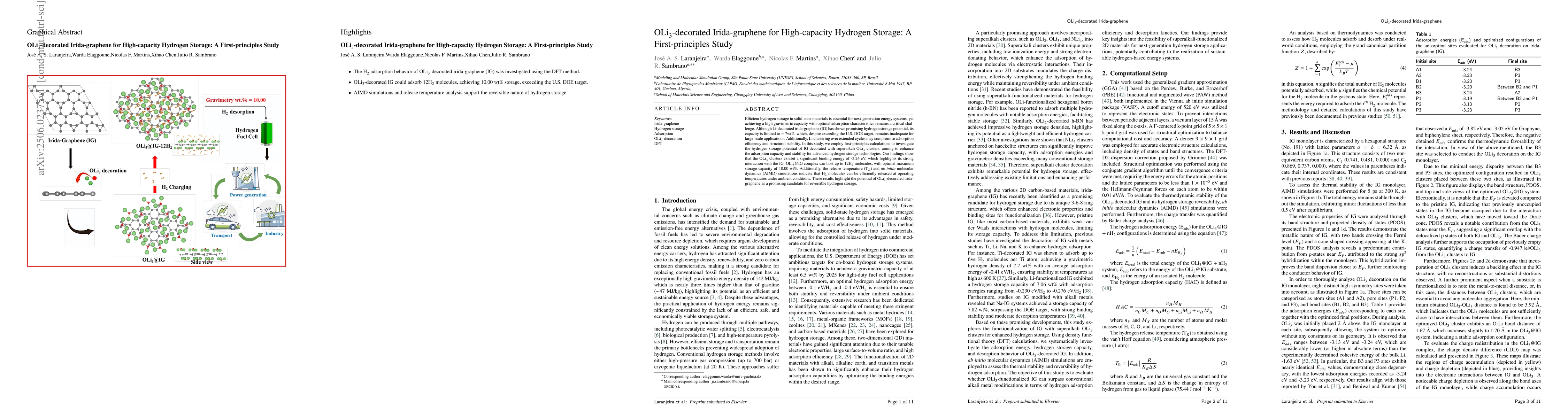
Efficient hydrogen storage in solid-state materials is essential for next-generation energy systems, yet achieving a high gravimetric capacity with optimal adsorption characteristics remains a critical challenge. Although Li-decorated irida-graphene (IG) has shown promising hydrogen storage potential, its capacity is limited to $\sim$ 7wt\%, which, despite exceeding the U.S. DOE target, remains inadequate for large-scale applications. Additionally, Li clustering over extended cycles may compromise adsorption efficiency and structural stability. In this study, we employ first-principles calculations to investigate the hydrogen storage potential of IG decorated with superalkali OLi$_3$ clusters, aiming to enhance the adsorption capacity and stability for advanced hydrogen storage technologies. Our findings show that the OLi$_3$ clusters exhibit a significant binding energy of -3.24 eV, which highlights its strong interaction with the IG. OLi$_3$@IG complex can host up to 12H$_2$ molecules, with optimal maximum storage capacity of 10.00 wt\%. Additionally, the release temperature (T$_R$) and \textit{ab initio} molecular dynamics (AIMD) simulations indicate that H$_2$ molecules can be efficiently released at operating temperatures under ambient conditions. These results highlight the potential of OLi$_3$-decorated irida-graphene as a promising candidate for reversible hydrogen storage.
Analysis
AI-generated · verify against the original paper
Generated Jun 8, 2025ResultsWhat the authors found
- OLi3 clusters exhibit a strong interaction with IG, demonstrated by a significant binding energy of -3.24 eV.
- OLi3@IG complex can host up to 12 H2 molecules, achieving an optimal maximum storage capacity of 10.00 wt%.
- H2 molecules can be efficiently released at operating temperatures under ambient conditions.
LimitationsWhere the findings need caution
- The study is theoretical and does not provide experimental validation.
- The long-term stability and scalability of OLi3-decorated IG for hydrogen storage applications need further investigation.
MethodologyHow the work was done
First-principles calculations were employed to investigate the hydrogen storage potential of irida-graphene (IG) decorated with superalkali OLi3 clusters.
SignificanceWhy the work matters
This research highlights the potential of OLi3-decorated irida-graphene as a promising candidate for reversible hydrogen storage, addressing the need for efficient solid-state materials in next-generation energy systems.
Technical contributionsWhat the work introduces
The investigation of OLi3-decorated irida-graphene for enhanced hydrogen storage capacity and stability using first-principles calculations.
NoveltyHow it differs from prior work
This work introduces the concept of using superalkali OLi3 clusters to decorate irida-graphene, significantly improving its hydrogen storage capacity and release characteristics compared to Li-decorated irida-graphene.
Future workQuestions that remain
- Conduct experimental studies to validate the theoretical findings.
- Explore the long-term stability and scalability of OLi3-decorated IG for practical hydrogen storage applications.
Discussion 0