OmniV-Bench: Can MLLMs Comprehend Immersive Spatio-temporal Scenes?
Abstract
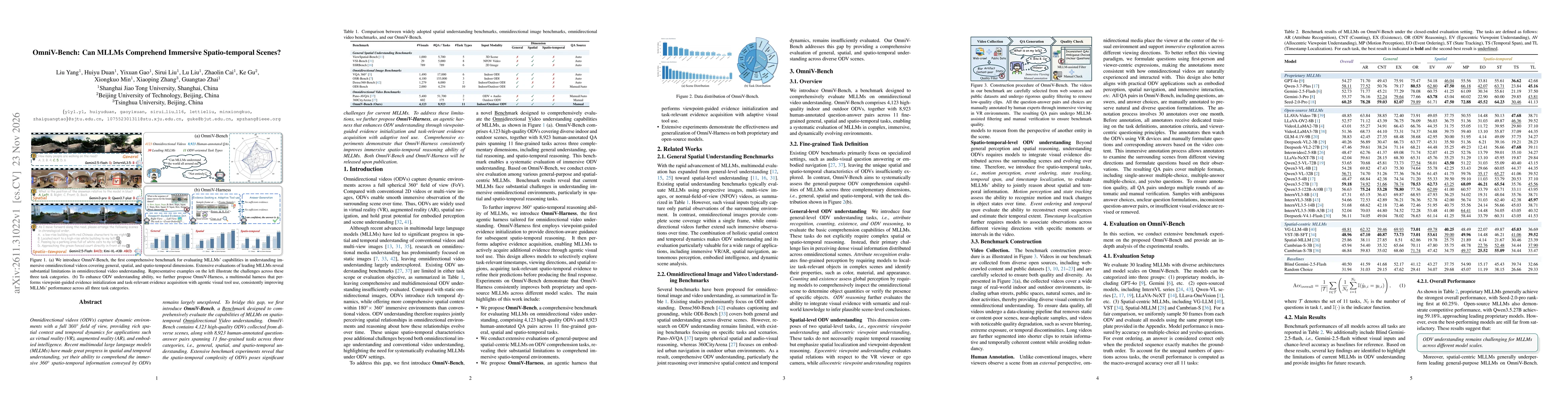
Omnidirectional videos (ODVs) capture dynamic environments with a full $360^\circ$ field of view, providing rich spatial context and temporal dynamics for applications such as virtual reality (VR), augmented reality (AR), and embodied intelligence. Recent multimodal large language models (MLLMs) have made great progress in spatial and temporal understanding, yet their ability to comprehend the immersive 360 spatio-temporal information conveyed by ODVs remains largely unexplored. To bridge this gap, we first introduce OmniV-Bench, a Benchmark designed to comprehensively evaluate the capabilities of MLLMs on spatio-temporal Omnidirectional Video understanding. OmniV-Bench contains 4,123 high-quality ODVs collected from diverse scenes, along with 8,923 human-annotated question-answer pairs spanning 11 fine-grained tasks across three categories, i.e., general, spatial, and spatio-temporal understanding. Extensive benchmark experiments reveal that the spatio-temporal complexity of ODVs poses significant challenges for current MLLMs. To address these limitations, we further propose OmniV-Harness, an agentic harness that enhances ODV understanding through viewpoint-guided evidence initialization and task-relevant evidence acquisition with adaptive tool use. Comprehensive experiments demonstrate that OmniV-Harness consistently improves immersive spatio-temporal reasoning ability of MLLMs. Both OmniV-Bench and OmniV-Harness will be released upon publication.
AI Key Findings
Get AI-generated insights about this paper's methodology, results, significance, and more — available when analysis has been generated.
Discussion 0