Abstract
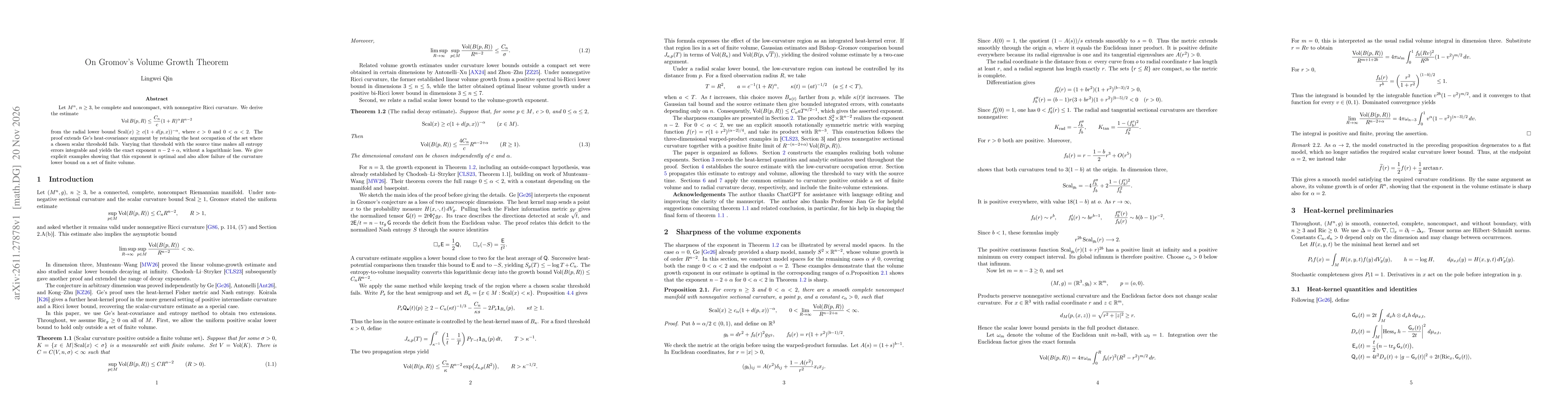
Let $M^n$, $n\ge3$, be complete and noncompact, with nonnegative Ricci curvature. We derive the estimate \[ Vol (B(p,R))\le \frac{C_n}{c}(1+R)^αR^{n-2} \] from the radial lower bound $Scal(x)\ge c(1+d(p,x))^{-α}$, where $c>0$ and $0<α<2$. The proof extends Ge's heat-covariance argument by retaining the heat occupation of the set where a chosen scalar threshold fails. Varying that threshold with the source time makes all entropy errors integrable and yields the exact exponent $n-2+α$, without a logarithmic loss. We give explicit examples showing that this exponent is optimal and also allow failure of the curvature lower bound on a set of finite volume.
Analysis
AI-generated · verify against the original paper
Generated Jan 1, 0001ResultsWhat the authors found
- Vol(B(p,R)) ≤ (C_n / c) (1+R)^α R^{n-2} under the radial scalar curvature lower bound Scal(x) ≥ c (1+d(p,x))^{-α} for 0<α<2.
- If the scalar curvature lower bound holds only outside a set of finite volume, then Vol(B(p,R)) ≤ C R^{n-2} for all R.
- The exponent n‑2+α is shown to be optimal by explicit examples.
- Corollary: With a finite‑volume exceptional set F, Vol(B(p,R)) ≤ C R^{n-2+α} for all R and limsup_{R→∞} Vol(B(p,R)) R^{-(n-2+α)} ≤ Cn/c.
LimitationsWhere the findings need caution
- The manifold must have non‑negative Ricci curvature and dimension n≥3.
- The decay exponent α is restricted to 0<α<2.
- Constants in the estimates depend on the manifold, base point, and the volume of the exceptional set.
MethodologyHow the work was done
The proof extends Ge's heat‑covariance and entropy method by retaining the heat occupation of the region where a chosen scalar curvature threshold fails, and by varying that threshold with the source time to make all entropy errors integrable, yielding the exact exponent without logarithmic loss.
SignificanceWhy the work matters
These results confirm Gromov's volume growth conjecture in full generality for non‑negative Ricci curvature, providing sharp volume growth rates without logarithmic losses and allowing curvature lower bounds to fail on finite‑volume sets.
Technical contributionsWhat the work introduces
Introduces a variable scalar curvature threshold coupled with source‑time scaling in the heat‑kernel/Fisher‑information framework, enabling precise control of entropy errors and removal of logarithmic factors in volume growth estimates.
NoveltyHow it differs from prior work
The variable‑threshold technique yields the exact exponent n‑2+α without logarithmic loss and extends the heat‑covariance argument to settings where curvature bounds fail on sets of finite volume.
Discussion 0