Online Mistake Detection in Instruction-Conditioned Procedural Video
Abstract
An assistant monitoring a person performing a procedure is most useful when it can detect mistakes while there is still time to recover. This requires judging actions against task instructions as the video unfolds, identifying the attempted step, locating it in time, and assessing its execution. Existing online detectors do not use the instruction text, while instruction-conditioned methods operate offline. In this paper, we study online, instruction-conditioned mistake detection in egocentric videos. Using only observed video, task instructions, and prior predictions, our model identifies and localizes completed action attempts and classifies them as correct, modified, slip, corrections, or additions; omitted steps are determined after the video ends. We compare a modular pipeline, with separate step identification, temporal localization, and execution verification, to a joint model that predicts all outputs in a single step. To support supervised learning from mistakes, we repartition EgoPER to include erroneous videos in all splits. The approaches achieve similar step-segmentation [email protected] (93.6% and 92.1%), while the joint model achieves higher binary mistake-detection [email protected] (84.1% vs. 80.7%), with its largest gain on slips (56.4% vs. 37.5%). Component-level analysis suggests that error propagation between stages contributes to the modular approach's lower detection score. On test videos containing mistakes, both designs outperform released AEM and ESTANet checkpoints under our evaluation protocol.
Analysis
AI-generated · verify against the original paper
Generated Jan 1, 0001ResultsWhat the authors found
- Both approaches achieve similar step‑segmentation [email protected] scores (93.6% modular, 92.1% joint).
- The joint model attains higher binary mistake‑detection [email protected] (84.1%) than the modular pipeline (80.7%).
- The joint model shows the largest gain on slip detection (56.4% vs. 37.5%).
- Both designs outperform the released AEM and ESTANet checkpoints on the erroneous‑video test subset.
- Component analysis indicates error propagation in the modular pipeline reduces its overall detection performance.
LimitationsWhere the findings need caution
- Omitted steps can only be identified after the video ends, limiting real‑time detection of missing actions.
- The modular approach suffers from error propagation between its sequential components, lowering detection accuracy.
MethodologyHow the work was done
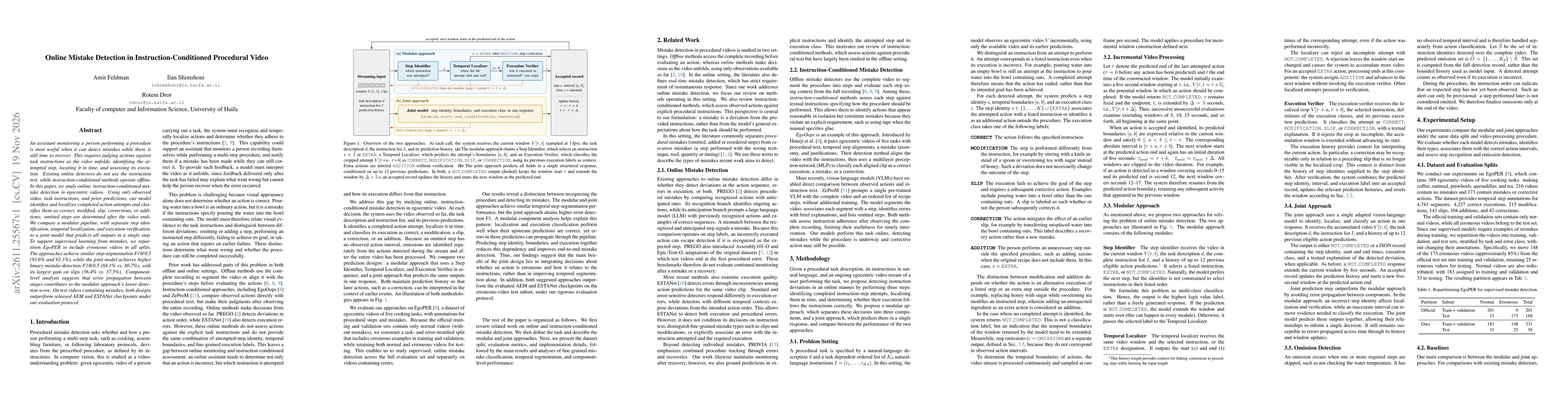
The paper proposes two approaches for online, instruction‑conditioned mistake detection in egocentric procedural videos: a modular pipeline that sequentially performs step identification, temporal localization, and execution verification, and a joint model that predicts step identity, temporal boundaries, and execution class in a single step, both conditioned on the observed video, task instructions, and a history of prior predictions.
SignificanceWhy the work matters
Enabling online detection of procedural mistakes conditioned on textual instructions allows an assistive system to provide timely feedback, helping users correct errors before task failure, which bridges the gap between offline instruction‑conditioned methods and existing online detectors.
Technical contributionsWhat the work introduces
Introduction of a novel online, instruction‑conditioned mistake detection framework with both modular and end‑to‑end joint architectures, a re‑partitioned EgoPER dataset that includes erroneous videos for supervised learning, and a comprehensive evaluation protocol comparing against state‑of‑the‑art online detectors.
NoveltyHow it differs from prior work
First study of online mistake detection that jointly leverages egocentric video, procedural text, and prediction history, providing fine‑grained classification of mistakes (correct, modified, slip, correction, addition) during video streaming.
Discussion 0